Health August 18, 2026
Biosimilars vs. Generics: How to Choose the Right Treatment Option
Imagine your prescription costs $20,000 a year. Now imagine it could drop to $3,000 without changing how well it works. That is the promise of follow-on medications. But when a doctor mentions switching you to a "generic" or a "biosimilar," do you know the difference? It matters because these two types of drugs are not the same thing, even though both aim to save you money.
Biosimilars and generics are often grouped together as cheaper alternatives to brand-name drugs. However, they come from different scientific worlds. One is a simple chemical copy; the other is a complex biological product that mimics the original. Understanding which one applies to your condition helps you make informed decisions about your care and wallet.
Quick Summary / Key Takeaways
- Generics are chemically identical copies of small-molecule drugs, offering 80-85% cost savings.
- Biosimilars are highly similar versions of large-molecule biologics, offering 15-20% cost savings.
- Generics require proof of bioequivalence; biosimilars require proof of no clinically meaningful differences.
- Only "interchangeable" biosimilars can be automatically substituted by pharmacists in many states.
- Your choice depends on whether your drug is a small molecule (generic available) or a biologic (biosimilar available).
The Core Difference: Chemistry vs. Biology
To understand why these drugs differ, look at what they are made of. Generic drugs are small molecules. Think of them like a LEGO set. If you have the instructions and the pieces, you can build an exact replica. In pharmaceutical terms, a generic drug contains the same active ingredient, strength, dosage form, and route of administration as the brand-name version. Because the molecular structure is simple and stable, scientists can synthesize it precisely in a lab.
Biosimilars are different. They are based on biologics, which are large, complex proteins made by living cells. You cannot just "copy" a protein in a test tube easily. Instead, manufacturers use cell lines (often Chinese hamster ovary cells) to produce the protein. The result is a product that is "highly similar" but not identical to the reference biologic. Tiny variations in the manufacturing process-like temperature or nutrient levels in the cell culture-can lead to minor structural differences. These differences must be proven to have no impact on safety or efficacy, but they mean a biosimilar is never an exact clone.
| Feature | Generic Drugs | Biosimilars |
|---|---|---|
| Molecular Type | Small molecule (< 1,000 daltons) | Large molecule (> 10,000 daltons) |
| Manufacturing | Chemical synthesis | Living cell production |
| Similarity Standard | Identical active ingredient | Highly similar, no clinically meaningful differences |
| Cost Savings | 80-85% vs. brand | 15-20% vs. reference biologic |
| Storage Requirements | Often room temperature | Strict refrigeration (2-8°C) |
| Regulatory Pathway | Hatch-Waxman Act (1984) | BPCIA (2010) |
How Approval Works: Bioequivalence vs. Totality of Evidence
The path to getting approved by the FDA differs significantly for these two categories. For generics, the standard is bioequivalence. This means the generic drug must reach the bloodstream at the same rate and extent as the brand-name drug. Researchers run pharmacokinetic studies showing that the area under the curve (AUC) and maximum concentration (Cmax) fall within an 80-125% range of the reference product. If this box is checked, the drug is considered therapeutically equivalent.
Biosimilars face a more rigorous hurdle called the "totality of evidence." Because the molecules are complex, you can't just measure blood levels. Manufacturers must provide extensive analytical data (using mass spectrometry and chromatography), animal study results, and clinical trial data. The goal is to show that any minor structural differences do not translate into different side effects, potency, or purity. As of 2023, the FDA has approved 46 biosimilars compared to over 11,000 generic products, reflecting the higher barrier to entry for biologics.
Cost Implications: Who Saves More?
If saving money is your primary driver, generics usually win by a landslide. Data from the FDA indicates that generic drugs typically offer discounts of 80-85% compared to their brand-name counterparts. For example, if a brand-name cholesterol pill costs $100, the generic might cost $15-$20.
Biosimilars also save money, but the percentage is lower. A 2023 analysis by the RAND Corporation found that biosimilars provide 15-20% cost savings over reference biologics. Why the gap? Biologics are expensive to develop and manufacture, so even a "cheaper" version retains a high price tag. However, in absolute dollars, the savings can still be substantial. For instance, a patient with rheumatoid arthritis switching from a reference adalimumab to a biosimilar might save thousands of dollars annually, even if the percentage discount is smaller than what you'd see with a generic antibiotic.
Interchangeability: Can Your Pharmacist Switch It Automatically?
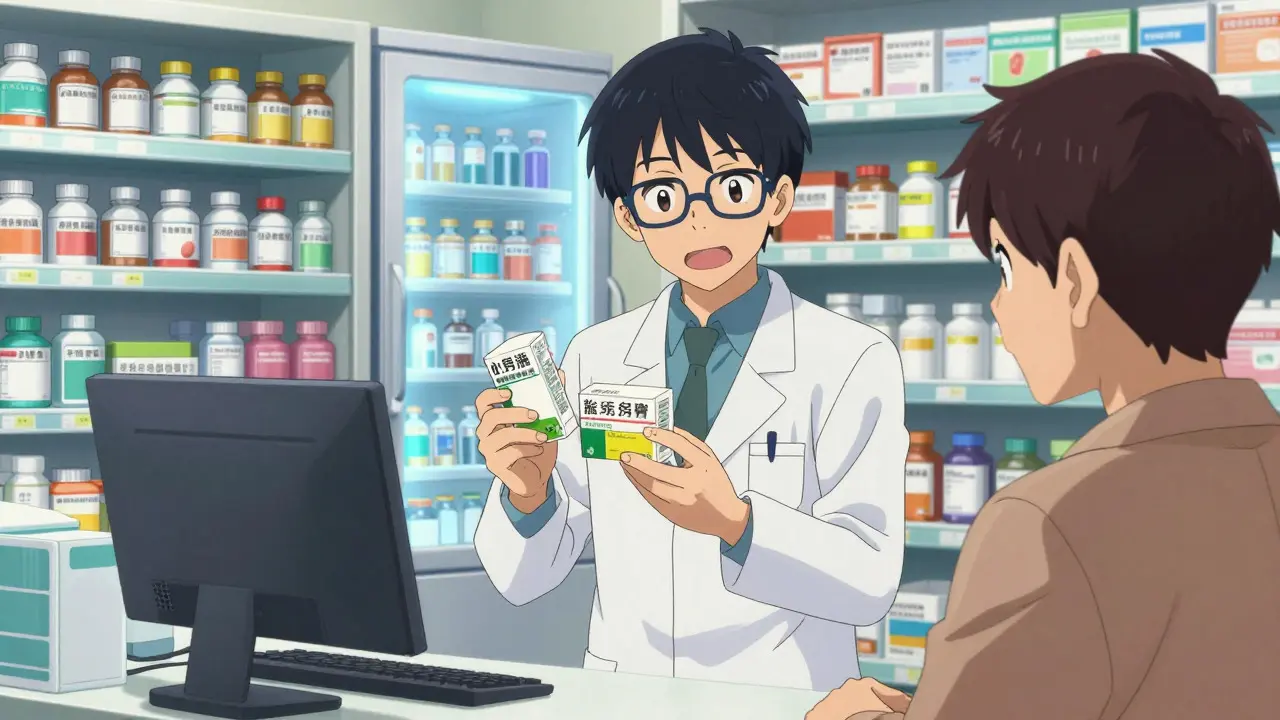
This is a practical detail that affects daily life. In 49 U.S. states, pharmacists can automatically substitute a generic for a brand-name drug unless the doctor writes "dispense as written." This makes generics seamless for most patients.
Biosimilars are more restrictive. Only those designated as "interchangeable" can be substituted automatically. To earn this label, a biosimilar must demonstrate that switching back and forth between the reference product and the biosimilar does not pose additional risks in terms of safety or efficacy. Even then, 28 states require the pharmacist to notify the prescriber within 72 hours of substitution. If your biosimilar is not labeled "interchangeable," you need a specific prescription for that exact product.
Clinical Considerations: Is It Safe for Your Condition?
For most common conditions, the science supports both options. A landmark 2019 JAMA study analyzing 47 randomized controlled trials found no significant differences in efficacy between generics and brand-name cardiovascular drugs. Similarly, a 2022 systematic review in Clinical Rheumatology involving 38,547 patients found no clinically meaningful differences in efficacy or safety between biosimilar and reference infliximab.
However, context matters. In sensitive populations, such as patients with inflammatory bowel disease, some experts caution about immunogenicity-the risk that the body develops antibodies against the biologic. While current evidence suggests this risk is minimal for approved biosimilars, doctors may monitor these patients more closely. Additionally, biosimilars generally require strict cold-chain storage (2-8°C), whereas many generics remain stable at room temperature. If you travel frequently or live in an area with unreliable power, this logistical factor might influence your preference.

Expert Perspectives and Patient Experiences
Healthcare providers are increasingly comfortable with these options, but familiarity varies. A 2023 American Medical Association survey found that 89% of physicians felt very confident prescribing generics, compared to 58% for biosimilars. Dr. Gary Lyman, co-director of the Hutchinson Institute for Cancer Outcomes Research, notes that biosimilars represent a significant opportunity to reduce oncology costs without compromising outcomes, provided patients are educated about the science.
Patient experiences reflect this transition. On forums like PatientsLikeMe, a rheumatoid arthritis patient reported saving over $8,000 annually after switching to an adalimumab biosimilar, noting that thorough explanation from their rheumatologist helped ease anxiety. Conversely, a 2022 survey by the National Psoriasis Foundation found that 42% of patients had concerns about biosimilar efficacy. Real-world data from the FDA's Adverse Event Reporting System shows comparable safety profiles, with only 0.12 adverse events per 100 patient-years for biosimilar infliximab versus 0.15 for the reference product.
How to Decide: A Practical Guide
When facing a choice, consider these steps:
- Check the Drug Type: Ask your pharmacist if the medication is a small molecule (generic available) or a biologic (biosimilar available).
- Review Insurance Formulary: Some insurance plans prefer biosimilars to lower costs. Check if your plan requires prior authorization for either option.
- Discuss Interchangeability: If you are using a biosimilar, ask if it is labeled "interchangeable." This determines if your pharmacy can swap it automatically.
- Consider Logistics: Do you have reliable refrigeration for biologics? Are you comfortable with potential pen device differences (e.g., insulin pens)?
- Talk to Your Doctor: Especially for chronic or complex conditions, ask if there are any specific reasons to stick with the reference product. For most cases, the answer will be no, but confirmation provides peace of mind.
Frequently Asked Questions
Are biosimilars exactly the same as brand-name biologics?
No, they are not identical. They are "highly similar" with no clinically meaningful differences in safety, purity, or potency. Minor structural variations exist due to the complexity of producing proteins from living cells, but these do not affect how the drug works in the body.
Can my pharmacist switch me from a brand-name drug to a generic without asking?
Yes, in most U.S. states, pharmacists can automatically substitute a generic for a brand-name drug unless the prescription says "dispense as written." For biosimilars, automatic substitution is only allowed if the product is labeled "interchangeable."
Which saves more money: generics or biosimilars?
Generics typically save more, offering 80-85% discounts off brand-name prices. Biosimilars offer 15-20% savings off reference biologics. However, because biologics start at a much higher base price, the absolute dollar savings from biosimilars can still be significant.
Do I need a new prescription for a biosimilar?
It depends. If the biosimilar is labeled "interchangeable," your pharmacist may substitute it automatically in many states. If it is not interchangeable, or if your state law requires it, you will need a specific prescription for that biosimilar product.
Are biosimilars safe for long-term use?
Current real-world data supports their safety. Studies show comparable adverse event rates to reference products. For example, a 2022 analysis found similar safety profiles for biosimilar infliximab. Doctors continue to monitor patients, especially in sensitive conditions, but major health organizations endorse their use as first-line therapy in many cases.