Health January 12, 2026
Carrying Medications in Original Containers While Traveling: What You Need to Know in 2026
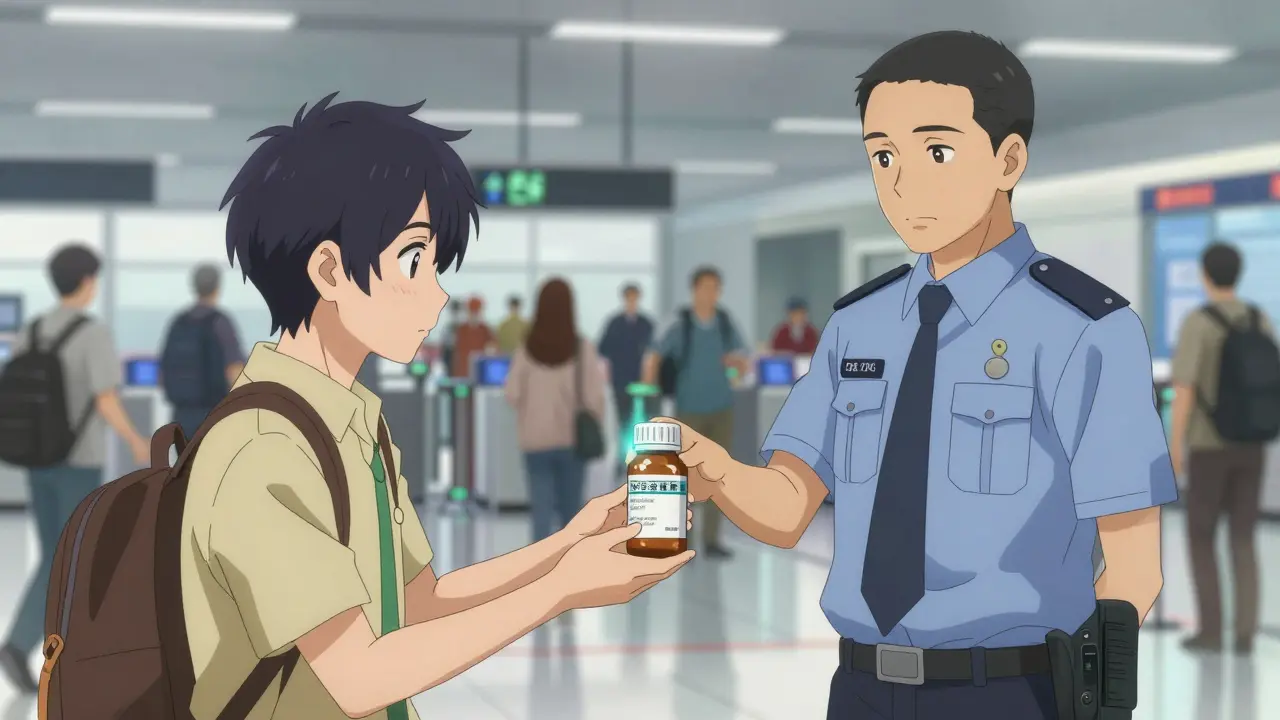
Imagine you’re at the airport, security line moving fast, and the officer asks about your meds. You reach into your bag and pull out a small plastic pill case-no labels, no bottles. Suddenly, you’re pulled aside for extra screening. Your flight is delayed. Your anxiety spikes. This isn’t rare. It happens to thousands of travelers every year, and it’s almost always avoidable.
The truth? The TSA doesn’t legally require you to keep your pills in original bottles. But that doesn’t mean you should skip them. In fact, if you want a smooth trip-especially when flying internationally-keeping your medications in their original pharmacy containers is the single best thing you can do.
Why Original Containers Matter More Than You Think
The TSA says you can carry pills in any container. That’s true. But here’s what they don’t tell you: state laws and international customs do. Thirty-seven U.S. states, including California, New York, and Texas, require prescription medications to be in original containers with the pharmacy label intact. If you’re driving across state lines or flying domestically, you could face legal trouble-even if you’re not breaking federal rules.
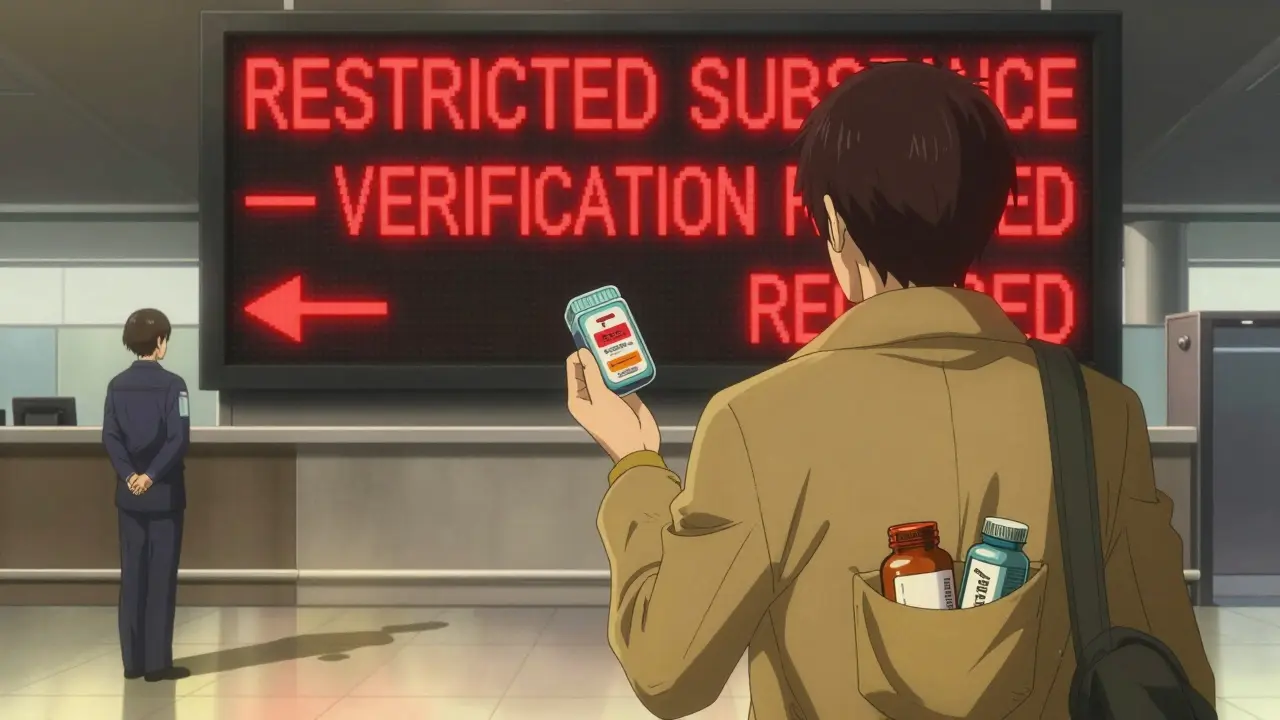
Internationally, it’s even stricter. Countries like Japan, South Korea, and the UAE ban common over-the-counter meds like Sudafed (pseudoephedrine). In Thailand and Singapore, codeine is illegal without a special permit. Adderall and Ritalin? Banned in multiple European and Middle Eastern countries. If your meds are in a pill organizer with no label, you’re essentially carrying an unmarked substance. Customs officers have zero way to verify it’s legal-and they’ll err on the side of caution. In 2023, U.S. Embassy data showed travelers with original containers had a 68% lower chance of being denied entry because of medication issues.
Original bottles aren’t just about legality-they’re about speed. A 2024 study at major U.S. airports found travelers with labeled medications cleared security 42% faster than those using unlabeled pill cases. Why? Because officers don’t need to question, isolate, or delay you. They see the name, dose, prescribing doctor, and pharmacy. Done.
What Counts as an “Original Container”?
An original container means the bottle or box your pharmacy gave you-complete with the pharmacy label. That label should include:
- Your full name
- The medication’s generic and brand name
- Dosage instructions
- Prescribing doctor’s name
- Pharmacy name and contact info
- Expiration date
Don’t rely on pharmacy bags or blister packs alone. Many pharmacies now use plastic bags with a printed label taped on. That’s not enough. If the label is removable, or if the bottle is unlabeled, you’re at risk. Always ask your pharmacist for the original bottle with the permanent label. If you’re refilling a prescription, request the bottle be kept intact.
For travelers on multiple meds, a pill organizer is tempting. But if you use one, bring the original bottles with you anyway. Or, take a clear photo of each bottle’s label and store it on your phone. Some travelers even print out a list with the same info and keep it in their wallet. But photos and printouts aren’t replacements-they’re backups.
Liquid Medications: The Bigger Hassle
Liquids like insulin, cough syrup, or liquid antibiotics are allowed in your carry-on-even if they’re over 3.4 ounces. But you must tell the TSA officer at the start of screening. Don’t wait to be asked. Say it clearly: “I have medically necessary liquids.”
Insulin pens? Fine. Nebulizer solutions? Fine. Liquid pain meds? Fine. But if you’re carrying a large bottle of liquid meds, keep it separate from your toiletries. TSA agents are trained to spot medical liquids, but they need you to flag them. No surprises.
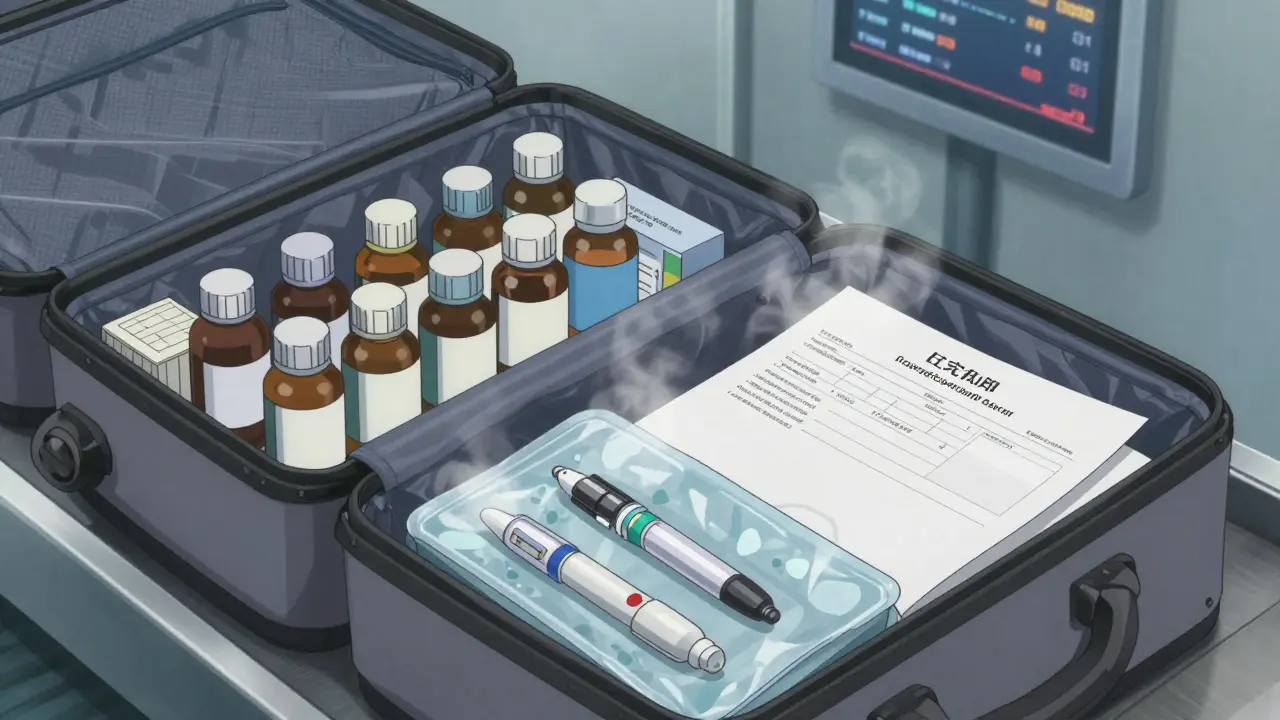
Temperature matters too. If your meds need refrigeration-like some biologics or insulin-bring a small cooler with ice packs. Ice packs are allowed, but they must be declared. If they’re melted, they’ll count as liquid. So freeze them solid before you leave. Some travelers use reusable gel packs that stay cold longer. Ask your pharmacist for recommendations.
Always Carry Documentation
Original bottles help-but a doctor’s letter helps even more. Get one before you leave. It should include:
- Your name and date of birth
- Your diagnosis (e.g., “Type 2 diabetes,” “ADHD”)
- List of all medications, including generic names
- Dosage and frequency
- Reason for use
- Doctor’s name, license number, phone, and clinic letterhead
Print it. Don’t just save it on your phone. Border agents may not have internet access. A printed letter on official paper carries weight. If you’re traveling with controlled substances (like opioids or benzodiazepines), this letter is non-negotiable. Some countries require it by law.
Also, bring a copy of your prescription. Not the receipt. The actual prescription document from your doctor. Many pharmacies can print this for you. Keep it in your travel documents folder.
What About Checked Bags?
Never put meds in checked luggage. Ever. Not even if you think you won’t need them on the flight. Planes get delayed. Bags get lost. Temperatures in cargo holds can drop below freezing or spike over 100°F. In 2023, 17.3% of medications in checked bags experienced temperature excursions that damaged the drug’s effectiveness. Insulin, epinephrine, and thyroid meds are especially sensitive.
Keep everything in your carry-on. Even backup meds. Even your vitamins. If you’re flying with a long layover or multiple flights, keep your meds with you at all times. Don’t trust the airline to return your bag before you need your pills.
International Rules Vary Wildly
There’s no global standard. What’s legal in the U.S. might be illegal in Thailand. What’s allowed in the UK might be restricted in Japan. Before you go, check the destination country’s rules.
Here are a few key examples:
- Japan: Max 1-month supply of any medication. No Adderall, Ritalin, or codeine. Original bottles required.
- United Kingdom: Max 30-day supply without special permit. Controlled drugs need prior approval.
- UAE: Pseudoephedrine, codeine, and benzodiazepines are illegal. Even with a prescription.
- Thailand: Codeine and tramadol require a special import permit. Carry your doctor’s letter.
- European Union: Since 2020, the EU Medicines Verification System requires traceable packaging. Original U.S. bottles are accepted, but some countries may ask for a translation of the label.
The U.S. Department of State lists 187 countries with specific medication restrictions. Don’t guess. Visit travel.state.gov and search for your destination. Or check the U.S. Embassy website for that country. They often have detailed guides.
What If You’re Running Low?
Bring extra. Always. At least a 10-15% surplus. Delays happen. Lost bags happen. Medical emergencies happen. You can’t always refill abroad. Many countries don’t carry the same brands. Others require a local prescription. And if you try to buy meds overseas, you risk counterfeit drugs. The FDA found that 11.7% of meds bought internationally are fake or ineffective-rising to 28.4% in Southeast Asia.
Don’t rely on local pharmacies. Even if they have the same name, the formula might be different. Your insulin from Germany might not work the same as your U.S. version. Your ADHD med from Spain might lack the active ingredient. Stick with what you know.
Future Changes: What’s Coming?
There’s movement toward digital solutions. In late 2024, the U.S. Department of Homeland Security plans to launch a pilot program at 12 major airports that lets travelers verify medications via a smartphone app. The International Air Transport Association is also testing a digital health pass for meds, expected to roll out in 2025.
But don’t wait for tech to save you. Even when digital systems exist, they’ll be optional. Original containers and doctor’s letters will still be the gold standard. They’re universal, reliable, and don’t need Wi-Fi.
Final Checklist Before You Fly
- Keep all medications in original pharmacy containers with labels.
- Bring a printed doctor’s letter with diagnosis, meds, and contact info.
- Carry a copy of your prescription.
- Never pack meds in checked luggage.
- Declare all liquid meds over 3.4 oz at the start of screening.
- Use ice packs for temperature-sensitive meds-but declare them.
- Bring at least 10-15% extra supply.
- Check your destination country’s medication rules on travel.state.gov.
- Keep all meds in your carry-on, accessible at all times.
Traveling with meds doesn’t have to be stressful. It just takes a little prep. Original containers aren’t just a suggestion-they’re your insurance policy against delays, denials, and dangerous misunderstandings. Do it right, and you’ll breeze through security. Skip it, and you might miss your flight-or worse.
Write a comment
Items marked with * are required.



13 Comments
Lauren Warner January 12, 2026 AT 14:16
Original containers aren't just about legality-they're about not getting detained at Dubai airport for carrying Adderall in a contact lens case. I've seen it happen. No one cares about your convenience. Customs doesn't care if you're 'just a traveler.' They care about paperwork. Skip the risk.
Craig Wright January 13, 2026 AT 02:59
It's astonishing how many Americans assume their domestic rules apply globally. The UK, Japan, and UAE have sovereign laws. Carrying unlabelled medication into these jurisdictions isn't just irresponsible-it's a violation of national sovereignty. This isn't a suggestion. It's a legal imperative.
Lelia Battle January 13, 2026 AT 08:47
I used to think the pill organizer was the height of efficiency until I got questioned at Heathrow with a bottle of melatonin in a plastic case. The officer didn't speak English well, but he knew the difference between a pharmacy label and a sticker. I learned that day: labels aren't bureaucracy-they're translation. They bridge the gap between your need and their duty.
Alex Fortwengler January 15, 2026 AT 08:39
They're lying about the 68% stat. TSA and the pharma lobby pushed this to sell more bottles. I've flown 87 countries with unlabeled pills and never been stopped. The real issue? They want you dependent on the system. Don't be fooled. Your body knows what it needs. Labels are for people who don't trust themselves.
jordan shiyangeni January 15, 2026 AT 14:27
It is deeply concerning that so many individuals treat their own medical regimen as a casual inconvenience rather than a medically regulated necessity. The failure to maintain original pharmaceutical containers is not merely a logistical oversight-it is an act of negligence that endangers not only oneself but also the integrity of international pharmaceutical regulation. One must ask: if you cannot respect the legal structure surrounding your own medication, how can you expect society to respect your autonomy?
steve ker January 15, 2026 AT 22:40
Original bottles? Lmao. Just carry your pills. Everyone else does. Why make it harder?
gary ysturiz January 17, 2026 AT 18:41
This is one of those things that seems like a hassle until you need it. I had a friend get stuck in Bangkok because her insulin was in a bag. She cried in the airport. Don't be that person. Keep your bottles. Print the letter. Bring the extras. It's not about rules-it's about peace of mind.
Jessica Bnouzalim January 19, 2026 AT 03:02
YES! YES! YES! I had a panic attack at LAX because my Adderall was in a pillbox and the officer looked at me like I was smuggling cocaine. I had the script on my phone-but they didn’t care. I cried in the security line. Now I carry the bottle, the letter, AND a printed copy. No more stress. This is life-changing advice.
laura manning January 20, 2026 AT 01:28
While the article presents a compelling case for adherence to pharmaceutical labeling protocols, it fails to adequately address the socioeconomic disparities that render compliance unattainable for a significant portion of the population. Many individuals receive medications in non-original packaging due to insurance restrictions, pharmacy logistics, or lack of access to prescriptive services. The implicit assumption that all travelers can afford to request original containers is not only empirically unsound but ethically problematic.
Bryan Wolfe January 21, 2026 AT 14:31
Love this breakdown! I used to think I was being smart with my pill organizer-until I missed a flight because they couldn’t verify my thyroid med. Now I keep everything in the original bottles, plus the doctor’s letter in my passport sleeve. It takes 5 extra minutes at home, but it saves hours at the airport. And honestly? It’s just… calmer. You’re not fighting the system-you’re working with it. Do it. You’ll thank yourself later.
Sumit Sharma January 21, 2026 AT 20:51
Pharmaceutical traceability is a non-negotiable component of global health security. The U.S. FDA’s pharmacovigilance framework does not extend beyond borders. Consequently, reliance on unlabeled containers constitutes a failure of due diligence under international medical governance standards. Always retain original packaging with full regulatory metadata.
Jay Powers January 22, 2026 AT 01:10
Just carry your meds in the bottle and don't overthink it. I've been flying for 20 years with insulin and ADHD meds and never had an issue. The key is to be calm and clear. If they ask, say 'medically necessary' and show them. No need for 10 pages of documents. Sometimes less is more.
Lawrence Jung January 24, 2026 AT 01:05
They say original containers are the gold standard but that's just institutional inertia. What if the label fades? What if the bottle breaks? What if your pharmacy gives you a bag with a sticky label? The real solution is a global digital registry linked to biometric ID. Until then we're all just playing dress-up with pharmacy bottles pretending it's 1998.