Health January 14, 2026
Generic Drug Labeling Requirements: What the FDA Mandates
When you pick up a generic drug at the pharmacy, you expect it to work just like the brand-name version. But do you know what’s written on the label? The FDA doesn’t just require generic drugs to have the same active ingredient or dose-they demand that the labeling be nearly identical to the brand-name drug’s. This isn’t a suggestion. It’s the law.
Identical Labeling Is the Rule
Under Section 505(j)(2)(A)(v) of the Federal Food, Drug, and Cosmetic Act, generic drug manufacturers must submit an Abbreviated New Drug Application (ANDA) that proves their product is bioequivalent to the brand-name drug, known as the Reference Listed Drug (RLD). But bioequivalence isn’t enough. The FDA also requires that the labeling-everything from the warnings to the dosing instructions-match the RLD exactly.
This includes the same boxed warnings, contraindications, adverse reactions, and clinical pharmacology details. Even the section headings must follow the Physician Labeling Rule (PLR), which went into effect in 2006. The PLR forces all prescription drug labels into a standardized 24-section format. That means if the brand-name drug’s label says “Warnings and Precautions” in a specific order, so must the generic. No exceptions.
The only things allowed to differ are the manufacturer’s name, address, and National Drug Code (NDC) number. That’s it. No rewording. No simplifying. No adding extra notes. If the RLD says “May cause dizziness,” the generic can’t say “May cause lightheadedness,” even if the meaning seems the same.
What Happens When the Brand Updates Its Label?
Here’s where things get complicated. When the brand-name manufacturer updates its label-say, to add a new warning about liver toxicity-the generic manufacturer can’t just follow suit. They have to wait. The FDA requires generic drug makers to update their labels to match the RLD “at the earliest time possible,” but they can’t act until the FDA approves the RLD’s change.
Brand-name companies can file a “Changes Being Effected” (CBE) supplement and update their label immediately, then notify the FDA afterward. Generic manufacturers don’t get that option. They’re stuck waiting for the FDA to approve the RLD’s change, then they must submit their own labeling supplement. Depending on the type of supplement, this can take anywhere from 30 days to 10 months.
This delay isn’t theoretical. A 2024 study in JAMA Internal Medicine found that 9,400 generic drugs-representing 89% of all prescriptions filled in the U.S.-were affected by this lag. In some cases, safety updates were delayed by 6 to 12 months. The 2022 valsartan recall is a chilling example: contamination risks were added to the brand label, but generics couldn’t update theirs until months later, leaving patients unaware of the danger.
Monitoring Changes Is Your Job (Not the FDA’s)
The FDA doesn’t call you to say the RLD label changed. You have to find out yourself. Generic drug manufacturers are legally responsible for monitoring labeling updates through Drugs@FDA, the FDA’s official database of approved drug labels. As of January 2025, it contains 2,850 reference listed drugs, with new updates posted every Tuesday.
Leading companies assign 3 to 5 full-time regulatory staff per 50 approved products just to track these changes. Smaller manufacturers often struggle. A December 2024 poll of 247 regulatory professionals found that 68% had trouble keeping up with labeling updates across multiple drug classes.
The FDA recommends subscribing to CDER’s electronic alerts, which send email notifications when labeling changes affect specific therapeutic areas. Eighty-two percent of surveyed companies rely on this system. Still, even with alerts, mistakes happen. A 2024 FDA audit found that 17% of RLD entries in the Orange Book had temporary inconsistencies with Drugs@FDA during transitions, forcing manufacturers to cross-check multiple sources.
What About Discontinued Brand Drugs?
What if the brand-name drug gets pulled from the market? That’s where the MODERN Labeling Act comes in. Passed in 2020, it was designed to fix a broken system: hundreds of generic drugs were stuck with outdated labels because their RLDs were no longer sold or approved.
Before this law, if the brand drug disappeared, the generic couldn’t update its label-even if new safety data emerged. Now, under the FDA’s January 2025 draft guidance, generic manufacturers can propose label updates based on the most recent RLD version, even if the brand product is gone. This applies to over 1,200 discontinued RLDs affecting 3,500 generic products.
But it’s not automatic. Manufacturers still need to submit a supplement and get FDA approval. The process is slower than for active RLDs, but at least there’s a path forward.
Electronic Labels and QR Codes Are Now Required
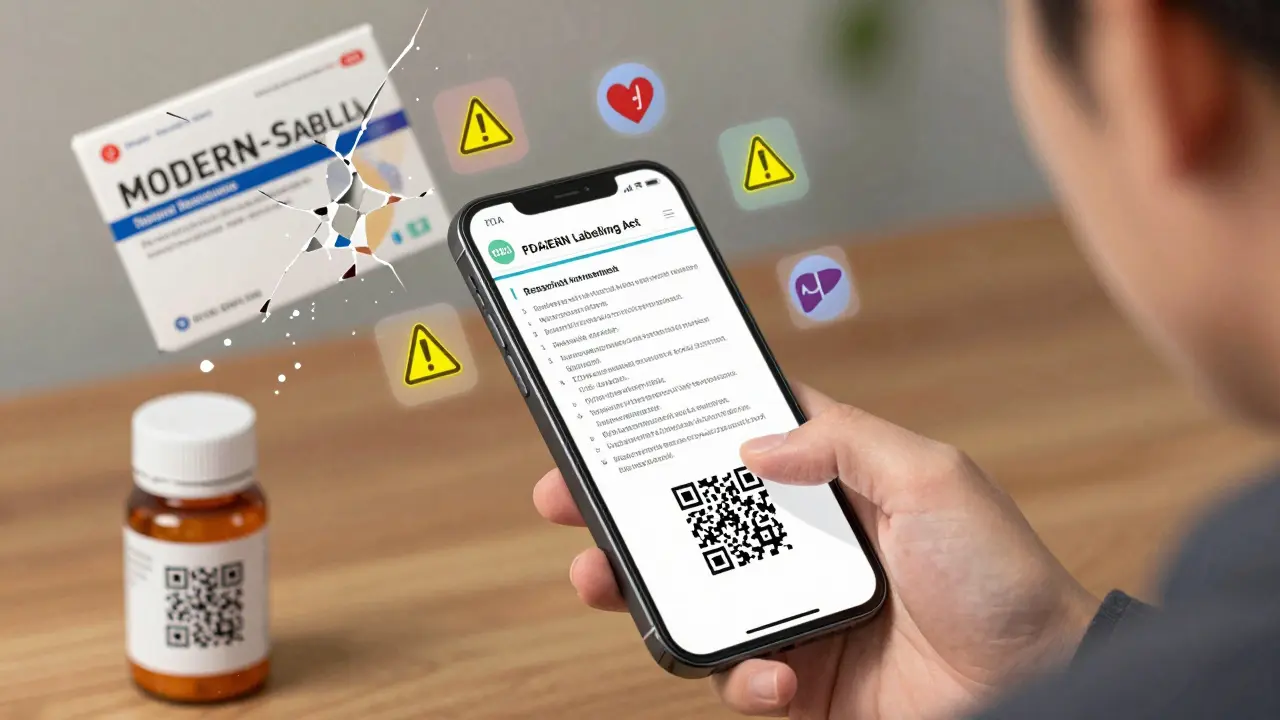
In 2025, the FDA mandated that medication guides for generics must include a direct link to the current FDA-approved labeling. This can be a URL or a QR code printed on the packaging. The link must point to a secure HTTPS page with a PDF version of the full prescribing information.
This change was driven by complaints from pharmacists and patients. Many generic labels were still printed in tiny, hard-to-read fonts. Now, patients can scan a code on the bottle and instantly see the most up-to-date safety info on their phone.
Manufacturers must ensure the link works, the PDF is current, and the server is reliable. The FDA has already issued warning letters to companies whose links led to broken pages or outdated documents.
Why This System Exists-and Why It’s Controversial
The FDA’s goal is consistency. If every version of a drug has the same label, doctors and pharmacists don’t have to guess which warnings apply. It reduces confusion and improves patient safety.
But critics argue the system is outdated. Dr. Robert Temple, former deputy director at CDER, called the current labeling rules “an unacceptable safety gap” for the 6 billion generic prescriptions filled each year. Dr. Janet Woodcock, former FDA deputy commissioner, admitted in early 2025 that while the MODERN Labeling Act provided tools, implementation is still messy.
The FDA has proposed new rules to let generic manufacturers update labels independently when new safety data emerges. That proposal, filed in November 2023, is still pending. If approved, it could be the biggest shift in generic labeling since the PLR.
Who Pays the Price?
Compliance isn’t cheap. Labeling updates account for 18-22% of total ANDA maintenance costs. Small manufacturers spend an average of $147,500 per product annually just to keep labels current. Large companies like Teva, Viatris, and Sandoz spend millions because they manage hundreds of products each.
Meanwhile, generic drugs save the U.S. healthcare system $647 billion a year. The FDA’s strict labeling rules help ensure those savings don’t come at the cost of safety. But as the number of generic prescriptions grows-92.6% of all prescriptions in the U.S.-the pressure to fix the system grows too.
What’s Coming Next?
The FDA is testing a new system called the Next Generation Generic Drug Labeling System, set to launch in Q3 2025. It uses AI to scan Drugs@FDA for changes and automatically notify manufacturers. Beta testing began April 15, 2025, with 15 major companies involved.
Industry analysts predict labeling compliance costs will rise 25-30% over the next five years. Manufacturers will need to invest $2.8 billion in automation, staff, and software just to keep up.
For now, the rules are clear: if the brand changes its label, the generic must follow-even if it takes months. Until the FDA’s proposed rule changes, the system remains a balancing act between uniformity and speed.
Can generic drug labels be different from the brand-name label?
No, generic drug labels must be identical to the Reference Listed Drug (RLD) in content, structure, and wording, except for the manufacturer’s name, address, and National Drug Code (NDC). Any other differences are prohibited under FDA regulations (21 CFR 314.94(a)(8)).
How often do generic drug labels need to be updated?
Generic labels must be updated as soon as possible after the FDA approves a change to the RLD’s label. The timeline depends on the type of supplement submitted: Prior Approval Supplements (PAS) take up to 10 months, Changes Being Effected (CBE) require 30 days, and CBE-30 allows immediate implementation with 30-day notification. Manufacturers must monitor Drugs@FDA weekly for updates.
What happens if a generic drug label isn’t updated?
Failure to update labeling to match the RLD can result in FDA enforcement actions, including warning letters. Between January 2023 and December 2024, the FDA issued 47 warning letters specifically for labeling discrepancies in generic drugs. Non-compliance can also delay approval of new products or lead to product recalls.
Do generic drugs have to follow the Physician Labeling Rule (PLR)?
Yes. All prescription drug labels, including generics, must follow the Physician Labeling Rule (PLR) format when the RLD does. The PLR requires a standardized structure with 24 sections, including Highlights, Recent Major Changes, Indications, Dosage, Contraindications, Warnings, and Clinical Pharmacology. Generics must convert to PLR format when the RLD updates to it.
Can generic manufacturers update labels independently for safety reasons?
Currently, no. Unlike brand-name manufacturers, generic companies cannot file a “Changes Being Effected” (CBE) supplement to update labeling for safety reasons without first waiting for the RLD’s label to be updated and approved by the FDA. A proposed rule change in 2023 would allow this in certain cases, but it has not yet been finalized as of January 2025.
Are QR codes required on generic drug packaging?
Yes. As of 2025, the FDA requires generic drug manufacturers to include a direct, secure HTTPS link or QR code on medication guides and packaging that links to the current FDA-approved prescribing information in PDF format. The link must be functional and point to the most recent version of the label.
What is Drugs@FDA, and why is it important?
Drugs@FDA is the FDA’s official online database of approved drug labeling and application information. Generic manufacturers must use it to monitor changes to their Reference Listed Drug’s label. It contains over 2,850 RLDs and is updated weekly. Relying on other sources, like the Orange Book, can lead to errors-FDA audits found 17% of RLD entries had temporary inconsistencies in 2024.
How does the MODERN Labeling Act help with discontinued brand drugs?
The MODERN Labeling Act allows generic manufacturers to update their labels based on the most recent version of a Reference Listed Drug-even if the brand product has been discontinued. Before this law, generics were stuck with outdated labels. Now, they can submit a supplement to update safety information, helping to close dangerous gaps in patient communication.
For now, the system remains rigid-but it’s evolving. The FDA’s next steps will determine whether generic drugs continue to serve as safe, affordable alternatives-or whether outdated rules put patients at risk.
Write a comment
Items marked with * are required.


15 Comments
Nilesh Khedekar January 16, 2026 AT 06:43
So let me get this straight: if a brand-name drug says 'May cause dizziness,' a generic can't say 'May cause lightheadedness'-even though they're the same thing? That's not regulation, that's linguistic terrorism. And we wonder why people don't trust the system.
Nat Young January 17, 2026 AT 10:01
The FDA's obsession with identical labeling is a bureaucratic farce. Bioequivalence is the only thing that matters. If a pill works the same, why does the font size of 'contraindications' need to be pixel-perfect? This isn't medicine-it's compliance theater.
Iona Jane January 19, 2026 AT 02:05
They're hiding something. Why would they block generic companies from updating safety info unless they're protecting Big Pharma? The delay? It's not bureaucracy-it's blood money.
Jaspreet Kaur Chana January 20, 2026 AT 02:29
Bro, I work in pharma in Mumbai and let me tell you-this is a nightmare. We have 30 generics on our roster, and every Tuesday we spend half the day checking Drugs@FDA like it's a lottery ticket. One typo, one missed update, and boom-FDA warning letter. And don't even get me started on the QR codes. My team spent three weeks fixing broken links because someone used HTTP instead of HTTPS. We're not robots. We're humans trying to keep people alive with 18-hour days.
Haley Graves January 22, 2026 AT 02:21
This is exactly why patient safety is slipping through the cracks. The system isn't broken-it's deliberately slow. If a brand adds a new warning, the generic should be able to follow immediately. Waiting months isn't caution, it's negligence. And the cost? It's not just money-it's lives.
Gloria Montero Puertas January 22, 2026 AT 11:59
Let's be clear: this isn't about safety. It's about control. The FDA, in its infinite wisdom, has created a system where innovation is punished and conformity is rewarded. And yet, somehow, we still pretend this is science.
Dan Mack January 22, 2026 AT 13:22
The MODERN Labeling Act? More like the MODERN LIE. They say it fixes things-but it doesn't. It just gives companies a paper trail to pretend they're trying. Meanwhile, people are still taking pills with outdated warnings because the FDA's database is a mess. I've seen it. I've had patients come in with expired labels. This isn't regulation. It's a public health time bomb.
Sarah Mailloux January 24, 2026 AT 01:43
I'm a pharmacist in Ohio. I've had patients ask me why their generic label says 'dizziness' but their friend's says 'lightheadedness.' I have to tell them it's the same thing. But I shouldn't have to explain that. The system should just work. QR codes are a start-but they're not enough. We need real change, not digital bandaids.
Niki Van den Bossche January 25, 2026 AT 15:43
The irony is sublime: we live in an age of AI-driven diagnostics, real-time biometric monitoring, and algorithmic pharmacogenomics-and yet we still require a generic drug label to mirror the brand's punctuation. This isn't science. This is liturgy. We worship at the altar of bureaucratic orthodoxy while patients bleed out in the margins.
Jan Hess January 25, 2026 AT 22:47
I think we're all missing the point. The real issue isn't the labeling-it's that we're still using paper-based systems in 2025. If the FDA just made Drugs@FDA the single source of truth and auto-synced it to manufacturers' systems, we wouldn't need 5 people per 50 products just to check for updates. This isn't rocket science. It's IT 101.
Diane Hendriks January 26, 2026 AT 21:32
The FDA’s rules are not merely archaic-they are an affront to American ingenuity. To demand uniformity in language while allowing corporate monopolies to dictate safety updates through proprietary channels is to institutionalize intellectual stagnation. This is not regulation; it is capitulation.
ellen adamina January 27, 2026 AT 01:13
I just want to say thank you for writing this. I've been a nurse for 18 years and I've seen too many patients confused by mismatched labels. I never knew why. Now I do. And I'm scared.
Frank Geurts January 27, 2026 AT 07:27
It is imperative to underscore that the Federal Food, Drug, and Cosmetic Act, as codified under Section 505(j)(2)(A)(v), mandates absolute fidelity in labeling between reference-listed drugs and their generic counterparts. Deviation, however semantically inconsequential, constitutes a statutory violation. The regulatory architecture, while burdensome, is not arbitrary-it is foundational to public trust.
Annie Choi January 27, 2026 AT 22:27
The Next Generation Labeling System sounds promising, but let's not forget: AI can't replace human oversight. We're talking about patient safety here. If the algorithm misses a change because Drugs@FDA had a 3-hour outage, someone dies. We need redundancy. We need audits. We need people-not just code.
Arjun Seth January 28, 2026 AT 00:20
This is why India makes better generics. We don't wait for FDA approval to update warnings. We fix them when we see them. If you're too scared to change a word, you don't belong in medicine.