Health March 6, 2026
Osteoporosis in Endocrine Disease: How FRAX and Bisphosphonates Guide Treatment
When your hormones are out of balance, your bones pay the price. It’s not just about feeling tired or gaining weight - in endocrine disorders like diabetes, thyroid disease, or low testosterone, your skeleton can weaken silently, turning everyday trips and falls into life-changing fractures. This isn’t rare. Around 1 in 3 women and 1 in 5 men over 50 will suffer an osteoporosis-related fracture in their lifetime. But for people with endocrine diseases, that risk jumps even higher - sometimes without any warning from a standard bone scan.
Why Endocrine Disorders Break Bones
Type 1 Diabetes: The Silent Bone Killer
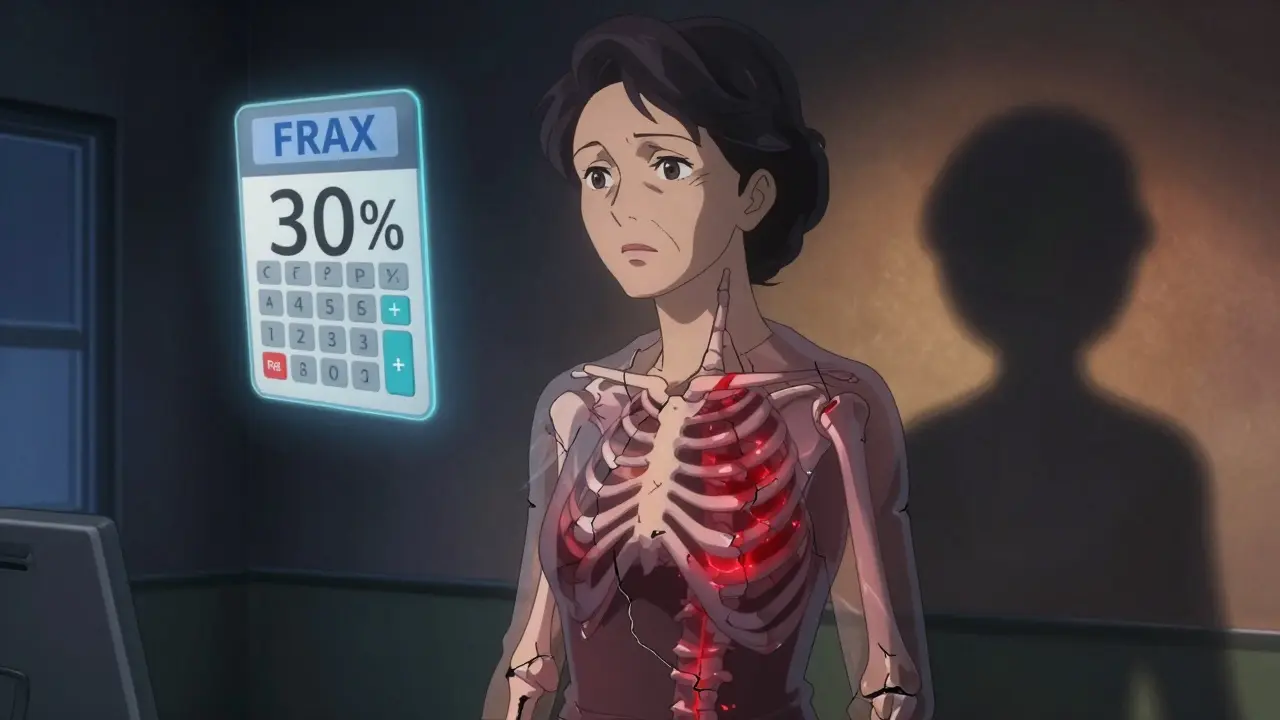
People with type 1 diabetes face a paradox: their bone density often looks normal on scans, yet they break bones 6 to 7 times more often than people without diabetes. Why? High blood sugar damages bone structure at a microscopic level. Collagen fibers, the scaffolding of bone, become stiff and brittle. Bone cells don’t regenerate properly. The FRAX is designed to estimate fracture risk based on age, weight, and past fractures - but it doesn’t account for this hidden damage. As a result, FRAX underestimates fracture risk in type 1 diabetes by about 30%. That’s why a 55-year-old with type 1 diabetes and a normal DEXA scan might still be at high risk.Thyroid Trouble: Too Much or Too Little
Whether you have an overactive thyroid (hyperthyroidism) or are on too much thyroid hormone replacement, your bones lose density faster. Studies show even mild, untreated hyperthyroidism increases fracture risk by 15-20%. That’s because excess thyroid hormone speeds up bone turnover. Bone is broken down faster than it’s rebuilt. The same goes for people who’ve had thyroid cancer and are on lifelong thyroid hormone suppression - their bones are under constant stress.Hypogonadism: When Hormones Drop
Testosterone and estrogen are bone builders. When levels fall - whether from natural aging, removal of the ovaries or testes, or treatments like prostate cancer therapy - bone loss accelerates. Men and women with hypogonadism can lose 2-4% of their bone mass each year. That’s 10 times faster than normal aging. A 60-year-old man on androgen deprivation therapy may have the bone strength of an 80-year-old within three years.FRAX: The Tool That Sees Beyond the Scan
The FRAX tool, created by the University of Sheffield, doesn’t just look at your bone density. It asks: How old are you? Are you a smoker? Did your parent break a hip? Are you on steroids? Have you had a previous fracture? Do you drink more than three units of alcohol a day? Do you have rheumatoid arthritis? For people with endocrine disorders, FRAX lets clinicians plug in those conditions directly. But here’s the catch: FRAX doesn’t treat diabetes or thyroid disease as separate risk factors in its algorithm - it only adjusts for them if you also enter your bone density score. That’s why the National Institutes of Health (NIH) says: “Don’t rely on FRAX alone if you have an endocrine disorder.” Instead, the best practice is to use FRAX with a DEXA scan. If your FRAX score without BMD is over 9.3% for major fractures, you should get a scan. If your score with BMD puts you above 20% for major fractures or 3% for hip fracture, treatment is recommended - regardless of whether your T-score is -1.5 or -2.8. And there’s a newer upgrade: the FRAX-adjusted Trabecular Bone Score (TBS). This doesn’t measure bone density - it measures bone quality. It looks at the honeycomb-like structure inside your bone. In endocrine diseases, that structure often crumbles even when density looks okay. TBS can catch that. It’s not yet routine everywhere, but leading endocrinology clinics in the UK and US now use it for patients with diabetes or long-term steroid use.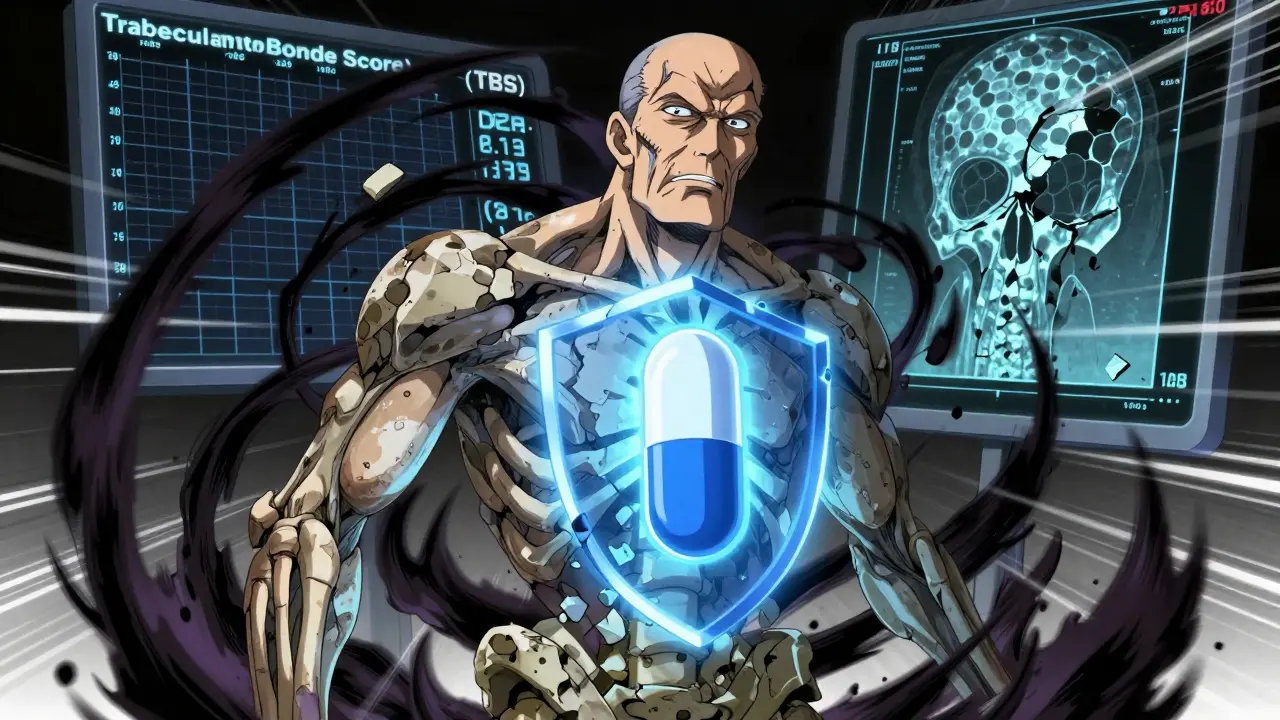
Bisphosphonates: The First-Line Defense
When the risk is high, doctors turn to bisphosphonates. These drugs - including alendronate (Fosamax), risedronate (Actonel), and zoledronic acid (Reclast) - work by shutting down the bone-eating cells called osteoclasts. They don’t build new bone. They just slow down the destruction. The numbers speak for themselves:- They cut vertebral fractures by 40-70%
- They reduce hip fractures by 40-50%
- In type 1 diabetes patients, they cut fracture risk even when BMD is normal
Who Gets Tested - and Who Doesn’t
The US Preventive Services Task Force (USPSTF) recommends DEXA scans for all women over 65 and younger women with risk factors. For men? Only those over 70 - unless they have a condition like diabetes, thyroid disease, or low testosterone. But here’s what many doctors miss: if you’re a 58-year-old woman with type 1 diabetes and a history of wrist fracture, you don’t need to wait until 65. Your FRAX score alone may push you over the 20% threshold. You’re already in the treatment zone. On the flip side, don’t get a DEXA scan just because you’re over 50 and “worried.” If you’re healthy, have no fractures, no steroid use, no endocrine disease, and your BMI is normal - FRAX says your risk is low. Scanning you adds cost, anxiety, and radiation - with zero benefit.
The Gaps and the Future
Even with FRAX and bisphosphonates, we’re still missing pieces. In type 1 diabetes, the tools still underestimate risk. Researchers are building diabetes-specific FRAX models. Early trials show they improve accuracy by 25%. That’s huge. It means a woman with type 1 diabetes and a T-score of -1.8 might now be flagged as high risk - when before she’d be told she’s fine. New tools are coming too. Blood tests that measure bone turnover, AI models that analyze DEXA images for microstructure, and even wearable sensors that track fall risk in real time. By 2025, 85% of endocrinologists are expected to use FRAX with endocrine-specific adjustments - not just as a tool, but as a standard of care. But here’s the bottom line: if you have an endocrine disorder, don’t wait for a fracture. Talk to your doctor about FRAX. Ask if your bone health has been evaluated. Push for a DEXA scan if you’ve had a fracture, are on long-term steroids, or have type 1 diabetes. And if your doctor says you’re not a candidate for bisphosphonates - ask why. The data is clear: for high-risk patients, these drugs save lives.Can FRAX be used for men with endocrine disorders?
Yes. FRAX works the same for men and women. Men over 50 with endocrine disorders - such as type 1 diabetes, hypogonadism, or hyperthyroidism - should have a FRAX assessment. Treatment thresholds are identical: 20% for major fractures or 3% for hip fracture. Many men are overlooked because osteoporosis is seen as a “women’s disease,” but bone loss in men with endocrine conditions is just as serious.
Do bisphosphonates work if bone density is normal?
Yes - and this is critical for endocrine patients. In type 1 diabetes, bone density often appears normal, but fracture risk is 6-7 times higher. Bisphosphonates reduce fractures in these patients even without low BMD. Treatment decisions should be based on FRAX risk scores and fracture history, not just T-scores.
Is it safe to take bisphosphonates long-term?
For most people, yes - but not forever. The standard course is 3-5 years for oral bisphosphonates or 3 years for IV zoledronic acid. After that, your doctor should reassess your risk. Long-term use (over 5-10 years) slightly increases the risk of rare side effects like atypical femur fractures or osteonecrosis of the jaw. That’s why treatment is paused and then re-evaluated using FRAX, TBS, and clinical factors.
Should I get a DEXA scan if I have hypothyroidism?
Only if you’re on too much thyroid hormone replacement or have other risk factors. Under-treated hypothyroidism doesn’t harm bone. But if you’ve been on high doses of levothyroxine for years - especially if you’re postmenopausal or over 65 - you should get a FRAX assessment. If your risk is elevated, then a DEXA scan follows.
What if my FRAX score is borderline?
If your 10-year risk for major fracture is between 15% and 20%, or hip fracture between 2% and 3%, your doctor should consider your full clinical picture. Do you have a history of falls? Are you on steroids? Do you smoke? Have you had a previous fracture? If yes, treatment may still be recommended. Shared decision-making is key - don’t let a number alone decide your care.
Next Steps for Patients
If you have an endocrine disorder:- Ask your doctor if you’ve had a FRAX assessment.
- Request a DEXA scan if you’ve had a fracture, are over 50, or have type 1 diabetes.
- If your FRAX score puts you over 20% for major fracture or 3% for hip fracture, ask about bisphosphonates.
- Don’t assume normal BMD means you’re safe - especially with diabetes.
- Ask about the Trabecular Bone Score (TBS) if it’s available - it gives a clearer picture of bone quality.
Write a comment
Items marked with * are required.






8 Comments
phyllis bourassa March 7, 2026 AT 20:57
Okay but let’s be real-FRAX is a glorified calculator that ignores how your body actually feels. I’ve got type 1 diabetes, normal DEXA, and I’ve already broken two ribs falling out of bed. My endo said ‘you’re fine’ until I showed up with a walking cane. FRAX didn’t see the crumbling inside my bones. TBS? Yes. Please. Stop relying on numbers when your body’s screaming.
And bisphosphonates? I took Fosamax for 3 years. My jaw started hurting. Not a joke. I had to get a root canal because my bone died. So yeah, I’m glad they work-but don’t act like they’re magic. You need to monitor. You need to listen. Not just plug in numbers and walk away.
Jeff Mirisola March 9, 2026 AT 02:28
As a guy who’s been on testosterone therapy since 35, I’m tired of people acting like osteoporosis is a ‘woman’s problem.’ My T-score was -2.1 at 48. I didn’t even know I was at risk until my physical therapist said, ‘Dude, you’re walking like an 80-year-old.’ FRAX caught it because I had a history of falls and low body weight. Bisphosphonates saved my spine. No regrets. If you’re a man with endocrine issues, get tested. Period. You’re not weak for needing help-you’re smart for asking.
Also, TBS is a game-changer. My clinic started using it last year. Suddenly, my ‘normal’ scan made sense. Bone structure matters more than density. This isn’t sci-fi-it’s 2024.
Amina Aminkhuslen March 10, 2026 AT 18:27
Y’all are overcomplicating this. If you’ve got diabetes, thyroid issues, or low hormones-your bones are on a rollercoaster with no seatbelt. FRAX? It’s a starting point. Not the whole damn ride.
I had a 58-year-old patient with type 1 diabetes, no fractures, normal DEXA. FRAX score without BMD? 11%. She laughed. Said she was ‘too active to break anything.’ Three months later-hip fracture from stepping off a curb. We started bisphosphonates. She’s walking again. No more cane. No more fear.
Stop waiting for the fracture. Start treating the risk. Your bones don’t care how ‘healthy’ you feel. They’re just trying to survive your endocrine chaos.
amber carrillo March 10, 2026 AT 20:03
I wish more doctors would read this. My mom has hypothyroidism and took levothyroxine for 15 years at high doses. She never got a scan until she fractured her wrist. Now she’s on Reclast. She’s 72 and walking without pain. This info should be standard in every endocrine clinic.
Tim Hnatko March 11, 2026 AT 20:18
I’m a nurse in an endocrine clinic. We screen every patient over 50 with diabetes or thyroid disease-even if they’re asymptomatic. We don’t wait for fractures. We use FRAX + TBS + clinical history. We’ve cut our fracture rates by 40% in 2 years.
Most patients don’t know about TBS. We print them a one-pager. I’ve had people cry because they finally understood why they kept breaking bones. It’s not aging. It’s hidden damage.
And bisphosphonates? They’re not scary. They’re lifesavers. We pause them. We reassess. We don’t just hand out prescriptions and forget.
Aaron Pace March 13, 2026 AT 13:22
OMG YES THIS IS SO IMPORTANT 🙌 I’m 49 with type 1 and my doc said ‘you’re fine’ until I broke my wrist. Now I’m on Fosamax and my TBS is garbage 😭 but at least I know. FRAX saved me. Don’t wait. Ask for TBS. Ask for bisphos. You’re not paranoid-you’re proactive 💪
Joey Pearson March 14, 2026 AT 03:48
You don’t need to be scared. You need to be informed. If you have an endocrine disorder, ask for FRAX. Ask for TBS. Ask about bisphosphonates. It’s not complicated. It’s your bones. Protect them.
Roland Silber March 15, 2026 AT 13:24
Let me add one thing: the real gap isn’t the tools-it’s access. Not every clinic has TBS. Not every patient can afford a DEXA scan. Not every doctor has time to explain FRAX properly.
I work in a rural clinic. We use FRAX without BMD as a screening tool. If the score is over 9.3%, we refer for DEXA. If it’s over 20%, we start treatment. We’ve had zero atypical femur fractures because we monitor closely.
And yes-bisphosphonates work even with normal BMD. The data is solid. But we also pair them with weight-bearing exercise, vitamin D, and fall prevention. No single tool fixes everything. It’s a system.
To anyone reading this: if your doctor dismisses you because your scan looks ‘fine,’ get a second opinion. You’re not being difficult. You’re being smart.