
Health September 1, 2026
Medication Safety Science: Balancing Risk, Benefit, and Real-World Evidence
You take a pill because you trust the science behind it. But here is the uncomfortable truth: the studies that approved your medication likely never included people like you. Most clinical trials involve just 1,500 to 5,000 healthy-ish participants for a short window. They miss rare side effects that only show up when millions of diverse patients start taking the drug in the messy, real world. This gap between controlled lab results and actual human biology is where medication safety science operates. It is not just about reading labels; it is about understanding how we detect harm after a drug hits the shelves.
If you have ever wondered why a warning label changes two years after a drug launch, or why some medications get pulled while others stay despite scary headlines, this guide breaks down the machinery. We will look at how experts weigh risks against benefits, the specific tools used to catch dangerous errors, and what the data actually says about keeping you safe.
Why Clinical Trials Are Not Enough
Think of a Phase III clinical trial as a high-stakes audition. It is rigorous, expensive (averaging $26 million per study), and strictly controlled. But it has blind spots. The average trial enrolls fewer than 800 people. If a serious side effect occurs in 1 out of every 10,000 users, the odds are high that no one in the trial will experience it. You simply cannot see a needle in a haystack if you only look at a handful of straw.
This is where pharmacoepidemiology steps in. Defined by the University of Florida College of Pharmacy as "the application of epidemiologic reasoning... to the study of the uses and effects of drugs in human populations," this field treats the entire population as the test subject. It emerged as a critical discipline after disasters like the thalidomide tragedy in the 1960s proved that pre-market testing could fail spectacularly. Today, it is recognized as the last, crucial stage of drug evaluation. It answers questions trials cannot: Does this drug interact with the five other pills my grandfather takes? How does it affect pregnant women who were excluded from the original study?
The Toolkit: How Scientists Hunt for Harm
So, how do researchers monitor millions of prescriptions without giving everyone a daily blood test? They use massive databases and clever statistical designs. Two main approaches dominate the landscape.
Observational Studies
These track large groups over time. Cohort studies follow patients forward from exposure to outcome. Case-control studies work backward, comparing those who got sick with those who didn’t. These methods leverage huge datasets like the FDA’s Sentinel Initiative, which covers over 190 million patients, and Medicare claims data covering 57 million beneficiaries. While cheaper than new trials (costing $150k-$500k versus millions), they face challenges. Confounding factors-like whether sicker patients naturally take more drugs-can skew results. Sophisticated techniques like propensity score matching help balance these variables, achieving 85-95% accuracy in controlling for known biases.
Within-Individual Designs
For acute events, scientists use self-controlled case series (SCCS). Here, each patient acts as their own control. Researchers compare the risk period right after taking the drug to a baseline period when the same person wasn’t taking it. This eliminates fixed traits like genetics or chronic conditions. It has proven highly effective for vaccine safety monitoring, reducing bias by up to 60% compared to traditional methods.
| Method | Best For | Cost & Speed | Key Limitation |
|---|---|---|---|
| Randomized Controlled Trial (RCT) | Initial approval; proving efficacy | $10M-$50M; Years | Limited sample size; excludes complex patients |
| Cohort Study | Long-term risks; common outcomes | $150k-$500k; Months/Years | Vulnerable to confounding variables |
| Self-Controlled Case Series | Rare, acute adverse events | Low cost; Fast | Only works for transient exposures/outcomes |
The Alert Fatigue Problem
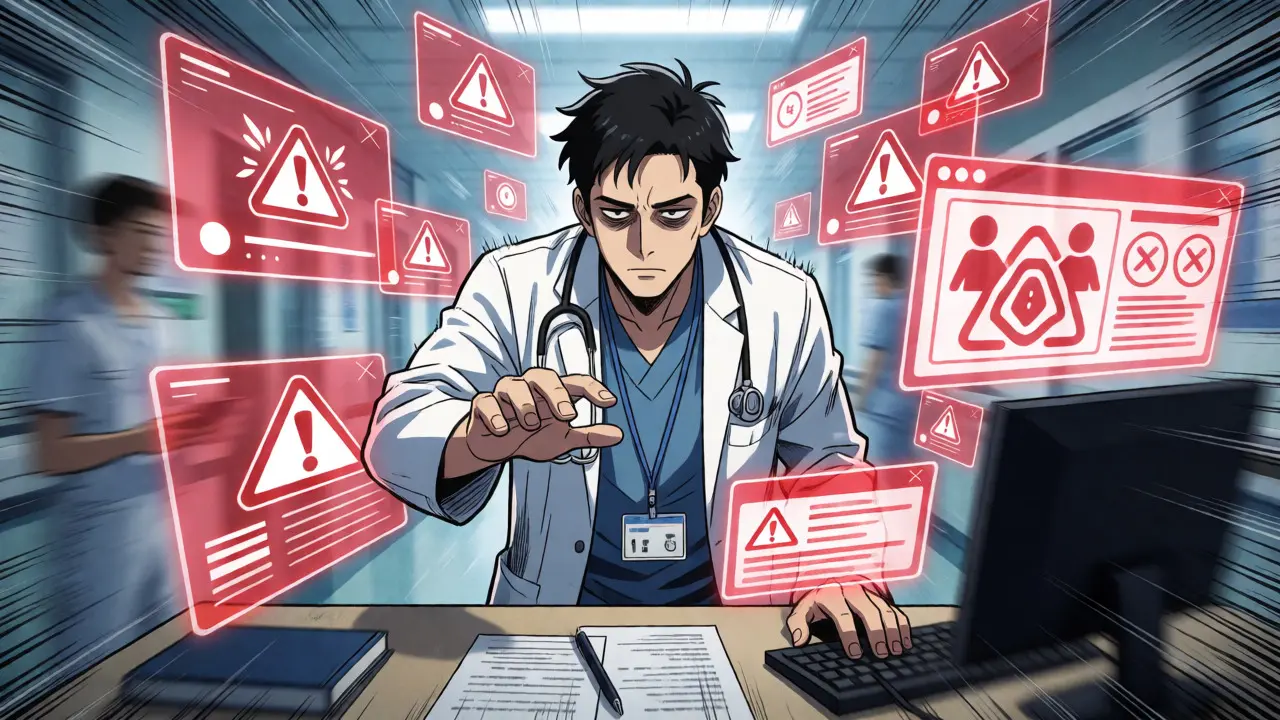
Detecting risk is half the battle. Preventing error in the hospital is the other half. Enter electronic health records (EHR) and clinical decision support (CDS) systems. By 2023, 87% of U.S. hospitals had implemented CDS interventions to flag potential dangers. Ideally, if you are allergic to penicillin, the system stops the prescription before it happens.
But there is a catch: alert fatigue. A study in the Journal of the American Medical Informatics Association found that prescribers override 89% of drug interaction alerts. Why? Because many alerts are low-risk or irrelevant. When doctors see pop-ups constantly, they start clicking "ignore" automatically. This human factor undermines the technology. At Kaiser Permanente Washington, fixing this required more than software updates. Implementing a specific protocol for phenobarbital in alcohol withdrawal reduced severe events by 42%, showing that targeted, evidence-based protocols beat generic warnings.
Weighing Risk Against Benefit
No medication is risk-free. The question is always relative. Is the risk acceptable given the benefit? Regulatory bodies like the FDA and the European Medicines Agency use Risk Evaluation and Mitigation Strategies (REMS) to manage this balance. Since the 2007 FDA Amendments Act, certain high-risk drugs require REMS plans to ensure benefits outweigh harms.
Consider opioids. In 2022, they were responsible for 80,000 deaths in the U.S. Yet, for acute pain management, they remain vital. The science doesn't say "ban them." It says "monitor them closely." Data shows that incorporating medication decision intelligence into CDS systems could reduce adverse drug events (ADEs) by up to 30%. This isn't just academic; it saves lives. For older adults, who often take five or more medications daily (polypharmacy), the risk of interactions skyrockets. Fifteen percent of Medicare beneficiaries suffer an ADE annually. The goal isn't zero risk-that's impossible-but optimized safety.

Real-World Evidence Is Taking Over
The era of relying solely on RCTs for post-market decisions is ending. Between 2015 and 2022, 78% of FDA safety communications relied on observational data rather than new trials. Why? Because it is faster and reflects reality. The FDA’s Sentinel System 3.0, launched in 2023, enhances real-time monitoring across integrated delivery systems. Early implementations of AI-driven predictive analytics have already shown a 22-35% reduction in high-alert medication errors.
Experts like Dr. Wayne Ray from Vanderbilt argue for an "evidence ecosystem." He notes that combining the internal validity of randomized trials with the external validity of observational studies creates a complete safety profile. This hybrid approach is becoming standard. Pharmaceutical companies now maintain dedicated pharmacovigilance departments (92% adoption rate) to feed this machine. The global market for this safety research is booming, projected to hit $11.7 billion by 2028.
What This Means for You
You don't need a PhD in epidemiology to navigate this. But you can be smarter about your meds. First, ask your pharmacist about interactions, especially if you take multiple prescriptions. Pharmacists are often the first line of defense against ADEs. Second, report side effects. Your anecdote becomes data point in the vast networks monitored by organizations like the PCORI and NIH. Third, understand that a changing label doesn't mean the drug is suddenly bad; it means our knowledge is refining.
As we move toward 2030, with 16% of the U.S. population over age 65, the stakes rise. Wearable tech and patient-generated data are being integrated into safety monitoring. The future of medication safety is less about guessing and more about continuous, real-time learning from billions of data points. It is a system designed to catch the needle in the haystack before it hurts you.
Why do medication warnings change after a drug is approved?
Clinical trials are limited in size and duration. Rare side effects may only appear when millions of diverse patients use the drug in real-world settings. Post-marketing surveillance through pharmacoepidemiology detects these issues, leading to updated labels.
What is the difference between a side effect and an adverse event?
A side effect is a known, expected reaction listed on the label. An adverse event (AE) is any unfavorable medical occurrence during treatment, regardless of causality. Not all AEs are caused by the drug, but they are tracked to identify potential links.
How does alert fatigue affect medication safety?
Electronic health record systems generate many warnings. Doctors often override 89% of these alerts due to frequency and low relevance. This desensitization can lead to missed critical interactions, highlighting the need for smarter, targeted clinical decision support.
Are observational studies less reliable than clinical trials?
They serve different purposes. Trials establish causality under ideal conditions. Observational studies reflect real-world use and detect rare events. While prone to confounding, modern statistical methods like propensity scoring significantly improve their reliability for safety monitoring.
What role does AI play in medication safety today?
AI is used for predictive analytics to prevent errors before they happen. Early implementations have reduced high-alert medication errors by 22-35%. Future developments aim to integrate wearable data for continuous, personalized safety monitoring.
Write a comment
Items marked with * are required.




13 Comments
Gurjit Singh September 1, 2026 AT 13:53
The moral obligation of pharmaceutical companies to test on diverse populations is non-negotiable. It is not enough to say "we tried." We must demand that the science reflects the reality of human biology across all races and genders. The current system fails the vulnerable by design.
Anderson Miller September 2, 2026 AT 22:20
Oh, look at us, pretending we understand risk while ignoring the fact that our doctors are basically clicking through pop-ups like they're playing a game of whack-a-mole with their own sanity... because apparently, alert fatigue is just code for "I don't have time to care about your specific genetic makeup" so we'll just prescribe the standard dose and hope for the best... which is fine if you enjoy gambling with your liver enzymes.
Tobi Oyewole September 4, 2026 AT 12:15
I appreciate the balanced perspective here. It is crucial to acknowledge that while clinical trials have limitations, they remain the gold standard for establishing initial causality. However, I respectfully suggest that the transition to real-world evidence must be handled with extreme caution to avoid misinterpreting correlation as causation in complex patient populations.
Sarah Kinch September 4, 2026 AT 15:20
whatever lol
the whole thing is just big pharma covering thier asses after they messed up again.
they knew about the side effects but hid them until it was too late.
now they use fancy words like pharmacoepidemiology to sound legit when its really just reactive damage control.
people get hurt because money matters more than safety.
simple as that.
Pearl Richardson September 6, 2026 AT 14:42
They are hiding the truth! 🚨 The AI systems aren't just monitoring; they are manipulating the data to keep profits high. 📉 Why do you think labels change? Because they wait until the lawsuits start rolling in. 👁️ The 'evidence ecosystem' is a trap to make us feel safe while they experiment on us. 🧪 Trust nothing. 🚫
larry williams September 8, 2026 AT 13:45
It is truly heartening to see such a comprehensive breakdown of how medication safety has evolved from the dark days of thalidomide to the sophisticated algorithms of today. We should take comfort in knowing that the system, while imperfect, is constantly striving to protect us, especially those of us who navigate the complexities of polypharmacy in our later years. Let us remain hopeful that technology will continue to bridge the gap between trial data and real-life outcomes, ensuring that every pill taken is a step toward better health rather than potential harm.
Stephen Horn September 9, 2026 AT 15:33
One must recognize that the general public lacks the epistemic framework to interpret these statistical nuances. While the article presents a digestible summary, it oversimplifies the profound methodological challenges inherent in observational epidemiology. To suggest that 'real-world evidence' can simply replace randomized controlled trials without addressing the deep-seated biases of unstructured data is intellectually lazy. We are witnessing the erosion of scientific rigor in favor of algorithmic convenience, a trend that favors corporate efficiency over genuine medical truth.
hareesh kumar September 9, 2026 AT 15:37
Wait hold on!!! Are we seriously saying that the FDA knows about rare side effects only AFTER millions take the drug??? That is insane!! What happens to the people who die in the first year?? They are just statistics?? And why do we trust these databases?? Who owns the data?? Is it the same companies making the drugs?? This smells fishy!! Like super duper fishy!! I bet they manipulate the numbers to hide the bodies!! 😱😱😱 Also my uncle took a pill and got weird rash and they said it was unrelated but it was clearly related!! So much drama!!
Venkatesan V.K. September 11, 2026 AT 03:57
Interesting read. Though, one wonders if the cost-benefit analysis mentioned truly accounts for the emotional toll on patients who discover their 'safe' medication has long-term consequences. It feels somewhat detached from the human experience of illness.
Marc-David Mayer September 11, 2026 AT 09:27
This is such great info! 🌟 Really helps to understand why our meds might change. Keep up the good work! 💪🏥
Kimberly Thomas September 12, 2026 AT 14:17
You talk about 'alert fatigue' like it's a new phenomenon. It's been happening for decades. Doctors are overworked and underpaid. Blaming the software is convenient. The real issue is that hospitals prioritize billing codes over patient safety. Your 'targeted protocols' are just another way to micromanage physicians who already know what they're doing. Stop blaming the tools and blame the management.
kishhore kumar September 14, 2026 AT 11:30
Hey this is cool stuff! I never realized how small the trial groups were. Like seriously 800 people?? That seems tiny for a whole country. How do they even pick who gets in the study? Do rich people get in more? Or is it random? Seems kinda unfair if they miss out on diversity. But yeah good point about asking pharmacists. I always forget to ask them about interactions. 😅🤔
Adam Cox September 15, 2026 AT 02:30
Stop pretending this is neutral science. It's marketing dressed up as data. You're selling fear so you can sell solutions. The 'risk-benefit' balance is rigged. Who decides what 'acceptable risk' is? Not you. Not me. It's the committee that approved the drug in the first place. Circular logic. Typical.