Health February 10, 2026
Sharing Your Medical History for Safe Medication Decisions
When you walk into a doctor’s office, clinic, or hospital, the most important thing you can bring isn’t your insurance card or ID-it’s your medication history. Too often, patients assume their doctor already knows what they’re taking. But in reality, up to 67% of people don’t accurately report their over-the-counter pills, supplements, or even herbal remedies. And that gap? It can cost lives.
Every year, tens of thousands of preventable medication errors happen in the U.S. alone. Many of them occur during care transitions-when you move from hospital to home, or from one provider to another. The good news? You have more power than you think to stop these errors before they start.
Why Your Medication List Matters More Than You Think
Medication reconciliation isn’t just a checklist. It’s a safety net. It’s the process where healthcare teams compare your current medications with what’s been prescribed, ordered, or dispensed at each transition point: admission, transfer, discharge. When done right, it cuts adverse drug events by 30-50%. That’s not a guess. That’s from data collected across hospitals nationwide.
Think about this: if you’re taking five or more medications, you’re at 88% higher risk for a medication error. Why? Because each new drug increases the chance of dangerous interactions. Insulin, blood thinners, and heart medications are especially risky. One wrong dose, one missed allergy, one unreported supplement-and you could end up in the ER.
Electronic systems now pull in data from 98% of U.S. pharmacies and all major pharmacy benefit managers. But here’s the catch: they still miss about 15-20% of prescriptions. Why? Cash-pay meds. Those bought without insurance. Those filled at a corner store. Those not tracked in the system.
What You Need to Track (Beyond Prescriptions)
Most people think their medication list means pills from the pharmacy. It doesn’t. It includes everything:
- Prescription drugs (even if you stopped taking them last month)
- Over-the-counter medicines (ibuprofen, antacids, cold pills)
- Vitamins, minerals, and supplements (fish oil, vitamin D, melatonin)
- Herbal remedies and teas (st. john’s wort, ginkgo, ginger)
- Topical creams and patches (pain relief, hormone patches)
- Illicit substances or alcohol use (yes, your doctor needs to know)
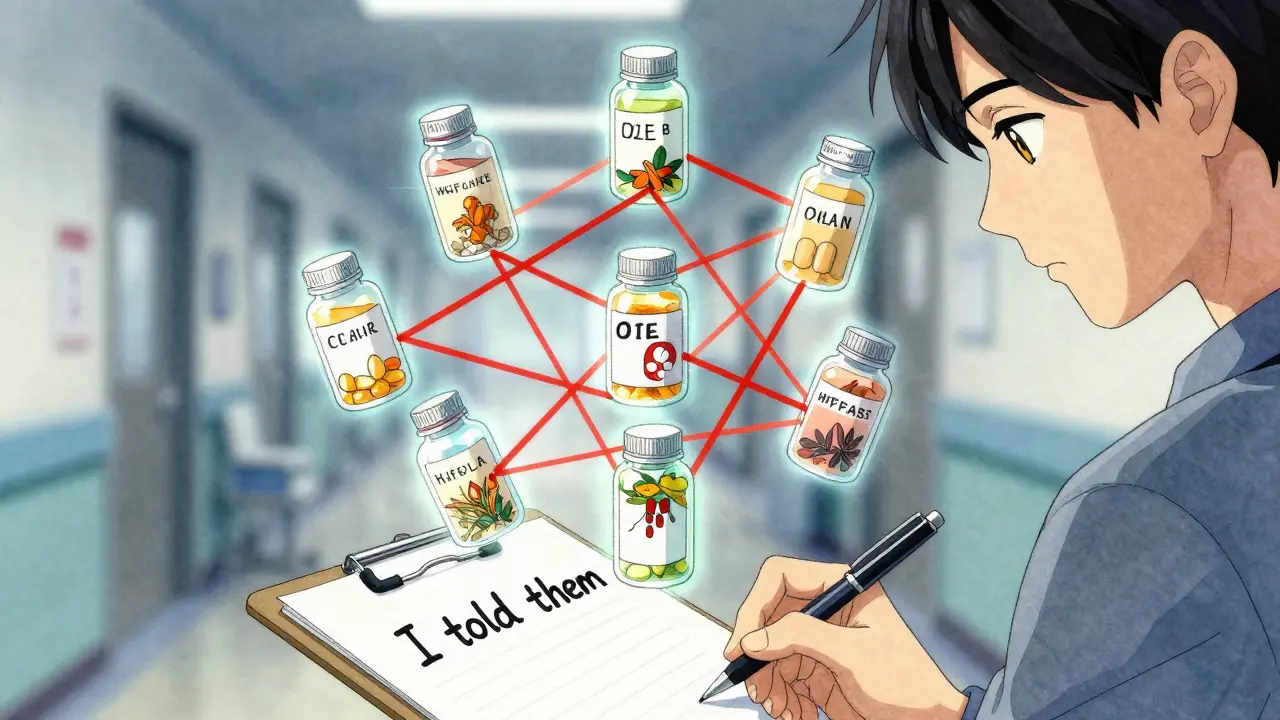
Why include all of this? Because st. john’s wort can cancel out birth control. Ginger can thin your blood and make surgery risky. Antacids can block absorption of your heart medication. These aren’t edge cases-they’re common mistakes.
One study found that 67% of patients didn’t mention their OTC meds during hospital admission. Another found that 41% of caregivers for elderly relatives had experienced at least one medication error because they couldn’t track what was being taken.
The Brown Bag Method: A Simple Trick That Works
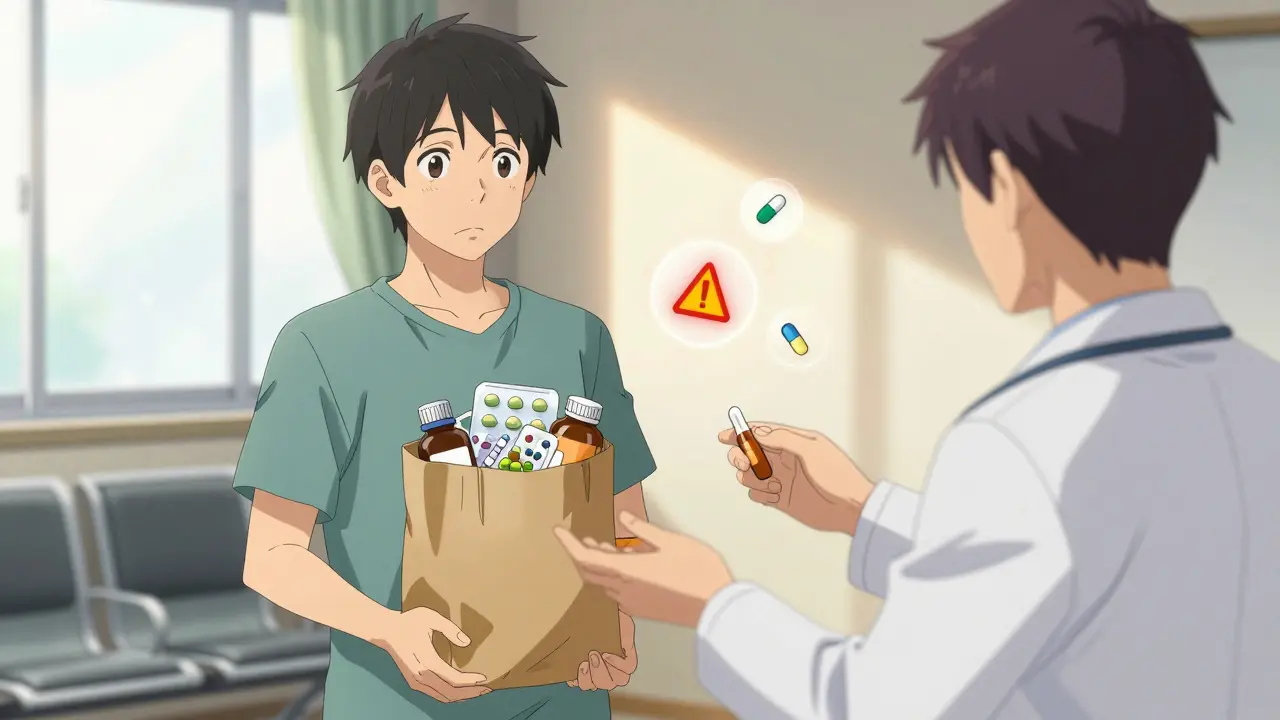
The most effective way to make sure nothing gets missed? The brown bag method. Literally, bring all your meds in a brown paper bag to every appointment.
It’s not fancy. It’s not high-tech. But it works. Patients who use this method reduce medication discrepancies by 40% compared to those who just try to remember. Why? Because seeing the bottles triggers memory. You remember that pill you took last Tuesday for a headache. You recall the herbal tea your sister swore by. You notice the expired patch stuck to the bottom.
Doctors and pharmacists love this. One nurse practitioner in Texas told me she cuts reconciliation time in half when patients show up with their bag. No guessing. No assumptions. Just facts.

How Technology Helps-And Where It Falls Short
Electronic health records (EHRs) and systems like Surescripts now exchange over 3 billion medication histories every year. They can flag dangerous interactions, check for duplicates, and even alert providers if a drug is out of stock.
But technology isn’t perfect. Systems still miss:
- Medications bought in cash
- Supplements taken irregularly
- Allergies not documented in every system
- Drugs prescribed by a specialist who doesn’t use the same EHR
Even with all the tech, clinicians still override nearly half of all drug interaction alerts because they’re too generic. “Too many warnings” leads to “I’ll ignore them all.” That’s a huge problem.
And here’s something few realize: your medication list in the hospital might not match what’s in your portal. A 2022 study found only 61% accuracy when relying solely on pharmacy claims data. That’s why patient input isn’t optional-it’s essential.
What You Can Do Right Now
You don’t need to wait for your next appointment. Start today:
- Go through your medicine cabinet. Take out every bottle, box, or packet.
- Write down the name, dose, frequency, and reason for each one.
- Include the pharmacy name and whether it’s prescription or OTC.
- Update it every time you get a new prescription or stop one.
- Keep a printed copy and a digital version on your phone.
- Bring the bag to every visit-even if you think it’s “just a checkup.”
Use your patient portal if your provider has one. Many now let you view, edit, and submit your own medication list. That’s your right. Use it.
What Providers Need to Hear From You
Doctors aren’t mind readers. If you say, “I take a few pills,” they’ll assume you mean your prescriptions. But what if you’re also taking turmeric for inflammation? Or melatonin every night? Or that cream for your eczema that’s been sitting in your bathroom for three years?
Be specific. Say: “I take 800 mg ibuprofen every morning for my back.” Not “I take pain meds.” Say: “I take 1,000 mg fish oil daily.” Not “I take vitamins.”
And if you’ve ever had an allergic reaction-itching, swelling, trouble breathing-say it clearly. Don’t say “I think I’m allergic.” Say: “I broke out in hives after taking penicillin in 2019.”
Use the SBAR method if you’re nervous: Situation (I’m here for my follow-up), Background (I’ve been on X, Y, Z for six months), Assessment (I’ve had stomach pain since starting Z), Recommendation (Can we check if Z is causing this?).
What Happens When You Don’t Share
Let’s say you’re admitted for chest pain. You’ve been taking warfarin, metoprolol, and a daily aspirin. You forgot to mention the turmeric supplement you started last week because “it’s natural.”
The hospital team prescribes a new antibiotic. Turmeric and warfarin together? That’s a recipe for dangerous bleeding. You’re discharged. A week later, you’re back in the ER. You didn’t lie. You just didn’t think it mattered.
That’s not rare. That’s routine.
One case study from Johns Hopkins showed that after implementing full medication reconciliation, anticoagulant-related adverse events dropped by 62%. That’s not luck. That’s communication.
Final Thought: You’re the Keeper of Your Own Safety
No system is perfect. No doctor has time to dig through every detail. But you do. You know what you take. You know how you feel. You know when something’s off.
Medication safety isn’t just about technology. It’s about trust. It’s about speaking up. It’s about showing up-with your bag, your list, and your voice.
Don’t wait for a mistake to happen. Start today. Update your list. Bring your pills. Ask questions. Be the person who says, “I think this might matter.”
Because in the end, the most powerful tool for safe medication decisions isn’t an app or an EHR. It’s you.
Why is it important to tell my doctor about over-the-counter meds and supplements?
Over-the-counter medicines and supplements can interact dangerously with prescription drugs. For example, fish oil and aspirin can both thin your blood-taking them together increases bleeding risk during surgery. St. John’s wort can make birth control, antidepressants, or heart medications ineffective. Many people assume these are harmless because they’re “natural,” but they’re still active chemicals. Not mentioning them can lead to serious health risks.
What is the brown bag method, and how does it help?
The brown bag method means bringing all your current medications-prescription, OTC, supplements-in a brown paper bag to your healthcare appointments. It helps because it gives providers a complete, visual picture of what you’re actually taking. Studies show it reduces medication discrepancies by 40% compared to just telling your doctor what you take. It also helps you remember things you might forget, like that herbal tea or a patch you haven’t used in months.
Can electronic health records catch all my medication errors?
No. While electronic systems pull data from pharmacies and insurers, they miss cash-pay prescriptions, supplements, and medications from providers who use different systems. One study found that even with advanced tools, only 52% of actual medication discrepancies were caught. That’s why patient input is still the most reliable source. Technology helps, but it doesn’t replace you.
How often should I update my medication list?
Update your list after every healthcare visit, prescription change, or new supplement start. Even if you think it’s minor-like stopping a painkiller or starting a new vitamin-write it down. Keep the list current on your phone and print a copy. Many hospitals require an updated list during admission, and having it ready saves time and prevents mistakes.
What should I do if I’m unsure whether a supplement is safe with my meds?
Don’t guess. Talk to your pharmacist. They’re trained to spot drug interactions and can check your full list in seconds. Many pharmacies offer free med reviews. If you’re seeing a new doctor, bring your list and say, “Can you check if these are safe together?” It’s part of their job. Never stop or start a supplement without asking.
Is it okay to tell my doctor about alcohol or recreational drug use?
Yes. Alcohol can interact with painkillers, antidepressants, and blood pressure meds, increasing side effects or reducing effectiveness. Recreational drugs can affect how your body processes medications. Your doctor needs this info to keep you safe. Everything you share is protected under HIPAA for treatment purposes. Being honest helps them make better decisions-not judge you.
Write a comment
Items marked with * are required.




10 Comments
Joanne Tan February 12, 2026 AT 00:11
I literally brought my brown bag to my last appointment and my nurse practically hugged me. 🙌 I had forgotten about that ginkgo supplement I took for a month last year-turns out it was messing with my blood pressure med. Now I keep a little notebook in my purse. It’s wild how such a simple thing saves so much stress. Thanks for the reminder!
Sonja Stoces February 13, 2026 AT 16:13
lol so you're telling me the system that's supposed to save us is missing 20% of meds? 😂 I work in healthcare and let me tell you, the EHRs are a dumpster fire. I once had a patient on 14 meds and the system only showed 7. The rest? Cash pay, bought from a guy in a parking lot. 🤡
Annie Joyce February 15, 2026 AT 01:33
The brown bag method is low-key magic. I’m a pharmacist and I’ve seen it turn chaos into clarity. One guy showed up with a bag full of 27 bottles-some expired, some half-empty, one labeled 'magic dust' (turns out it was turmeric). We caught three dangerous combos he didn’t even know about. It’s not about being perfect-it’s about being present. Bring the damn bag. Your future self will thank you.
Rob Turner February 16, 2026 AT 05:54
I’ve been doing this since my dad had a bad interaction with his blood thinner and a herbal tea. It’s funny how something so simple-writing things down-feels radical in a world obsessed with apps and AI. But tech doesn’t care if you forgot your 3pm melatonin. You do. And that’s the real safety net. 🌿
Luke Trouten February 17, 2026 AT 22:42
I really appreciate how this post doesn’t blame patients or providers. It’s a systems issue, not a personal failing. We’re all trying to navigate complexity with incomplete data. The fact that we’re even talking about this-honestly, naming the gaps-is the first step toward real change. Thank you for not sugarcoating it.
Jonathan Noe February 19, 2026 AT 02:50
I’ve been tracking meds for 12 years. I have a spreadsheet, a Notion database, a QR code on my wallet, and a voice memo called 'Meds: Don't Die.' I even color-code by category. Blue = blood pressure, red = pain, green = 'I think this helps but I'm not sure.' My doctor says I'm 'overkill.' I say I'm alive. You don't get to be casual about your meds. Not after seeing what happens when you are.
Suzette Smith February 20, 2026 AT 20:58
I get why you say to bring everything, but what if you’re embarrassed? Like… I take melatonin and CBD gummies. And I don’t really want to say that out loud. Is that dumb?
Autumn Frankart February 22, 2026 AT 09:30
This whole thing is a government ploy. They want you to document everything so they can track you. Next thing you know, they’ll be scanning your pill bottles for 'health behavior patterns.' I don’t trust EHRs. I don’t trust pharmacies. I don’t trust YOU. I keep my meds in a locked safe. And I only tell my cat. 🐱
Sophia Nelson February 23, 2026 AT 07:42
I’m tired of being told to 'just bring your meds.' What if I’m homeless? Or can’t afford to keep them all? Or live 3 hours from a pharmacy? This advice is for rich people with good insurance. Why isn’t anyone talking about that?
Stephon Devereux February 24, 2026 AT 02:02
I used to think meds were just pills. Then I had a stroke. Now I know they’re threads in a tapestry-each one holding something together. Miss one thread? The whole thing unravels. I now carry a laminated card in my wallet: 'I take X, Y, Z. I’m allergic to penicillin. I use CBD for anxiety. I drink 1 glass of wine a night.' It’s not fancy. But it’s mine. And when I couldn’t speak after the stroke? That card saved me. Don’t wait for a crisis to start. Start now.