Health December 9, 2025
High-Dose Statins After Stroke: What You Need to Know About Benefits and Risks
Statin Benefit Calculator
This tool helps you understand the trade-offs of high-dose statins after an ischemic stroke based on your specific situation.
Results
Select your stroke type and history to see your personalized risk assessment
Why High-Dose Statins Are Used After a Stroke
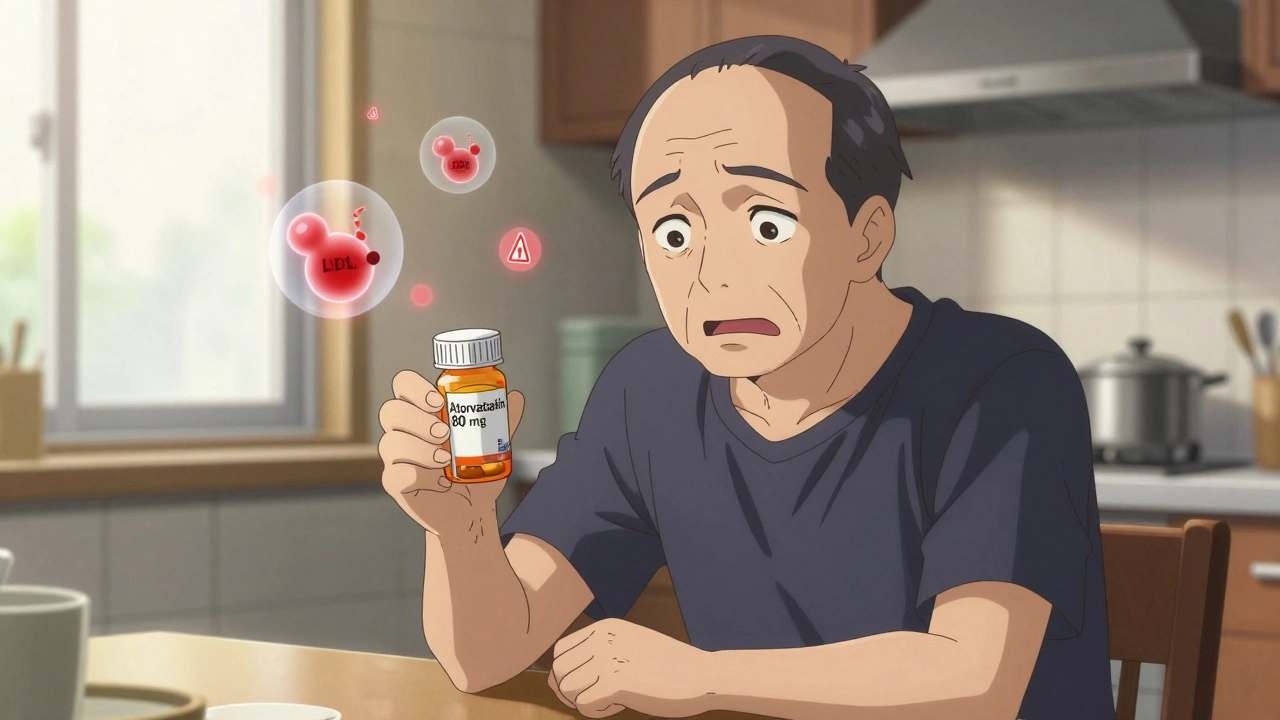
After an ischemic stroke, the goal isn’t just to recover-it’s to prevent another one. That’s where high-dose statins come in. These medications, especially atorvastatin 80 mg, are prescribed to drastically lower LDL cholesterol, the kind that builds up in arteries and causes blockages. The most famous study backing this approach, the SPARCL trial from 2006, followed over 4,700 people who’d recently had a stroke or TIA. Those taking high-dose atorvastatin had a 16% lower chance of having another stroke over nearly five years. That might sound small, but in real numbers, it meant 2.2 fewer strokes per 100 people over that time. For someone who’s already had one stroke, that’s a big deal.
It’s not just about cholesterol. Statins also reduce inflammation in blood vessels and help the lining of arteries work better. These so-called "pleiotropic" effects may be just as important as lowering LDL. That’s why guidelines from the American Heart Association and American Stroke Association say you should use "intensive lipid-lowering therapy" after stroke-even if you’ve never had heart disease. They don’t say you must take 80 mg of atorvastatin, but they do say the goal is to cut LDL by at least half.
The Trade-Off: Higher Risk of Brain Bleeds
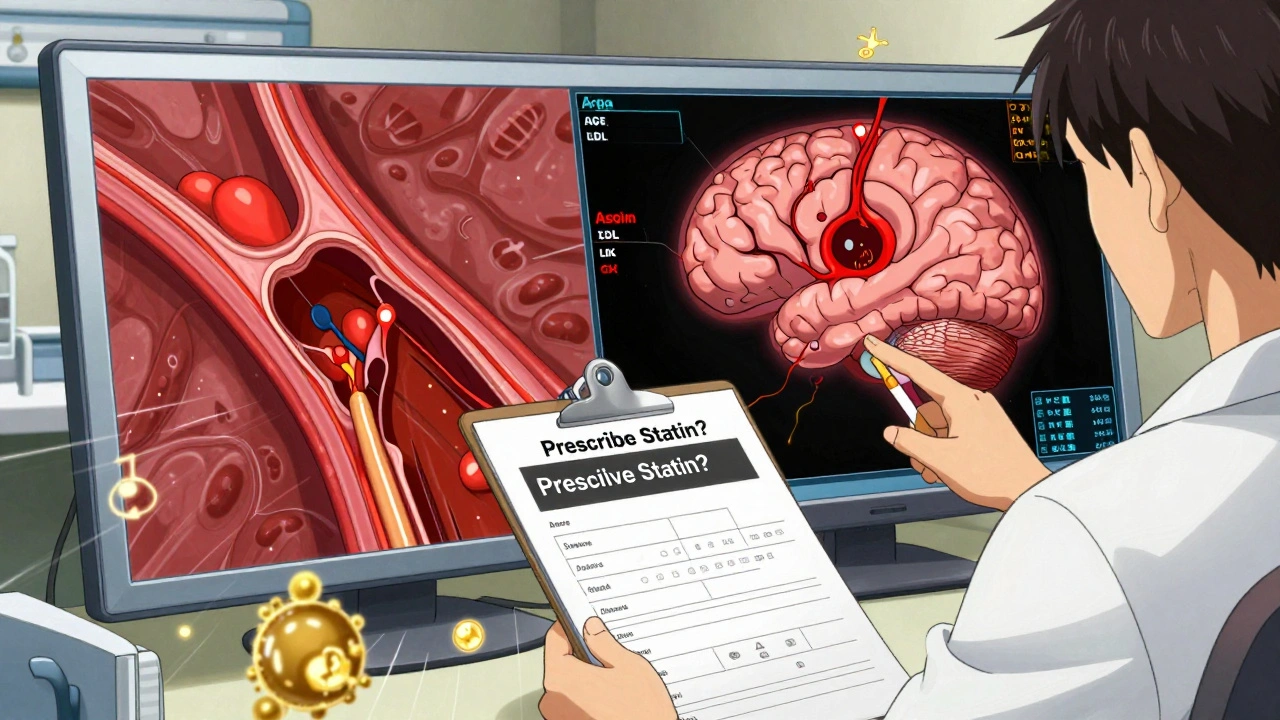
But there’s a catch. The same SPARCL trial found that high-dose statins increased the risk of hemorrhagic stroke-the kind caused by bleeding in the brain. In the study, 2.3% of people on atorvastatin had a brain bleed compared to 1.4% on placebo. That’s less than 1% higher overall, but for someone who’s already had a bleed or has weak blood vessels, that extra risk matters. This isn’t a theoretical concern. A 2022 review of 11 clinical trials and 12 large patient studies confirmed that higher statin doses raise the risk of hemorrhagic stroke, while lower doses don’t. And if you’ve had a hemorrhagic stroke before, statins might not help you at all. In fact, some experts now say PCSK9 inhibitors, a newer class of cholesterol drugs, may be safer for these patients because they don’t carry the same bleeding risk.
So who should take high-dose statins? The biggest benefit is seen in people whose stroke was caused by atherosclerosis-fatty buildup in the arteries. If your stroke came from a heart rhythm problem like atrial fibrillation, statins don’t offer the same protection. That’s why doctors now look at the cause of your stroke before deciding on the dose. It’s not one-size-fits-all.
Side Effects You Can’t Ignore
Most people tolerate statins fine. But not everyone. About 5 to 10% of patients report muscle pain, weakness, or cramps. It’s often mild, but it’s real. Some people say they feel foggy or have trouble remembering things-though studies haven’t proven this is directly caused by statins. Still, if you feel off, you’re not imagining it. The FDA issued a warning in 2011 about simvastatin 80 mg because it raised the risk of severe muscle damage, especially when taken with common blood pressure drugs like amlodipine. That’s why many doctors avoid simvastatin at high doses now.
Liver enzymes can also rise. In SPARCL, 1.2% of people on atorvastatin 80 mg had persistent liver enzyme elevations, compared to 0.2% on placebo. That doesn’t mean liver damage-it just means your doctor needs to check your blood work every few months. If enzymes go too high, they’ll lower your dose or switch you to another statin.
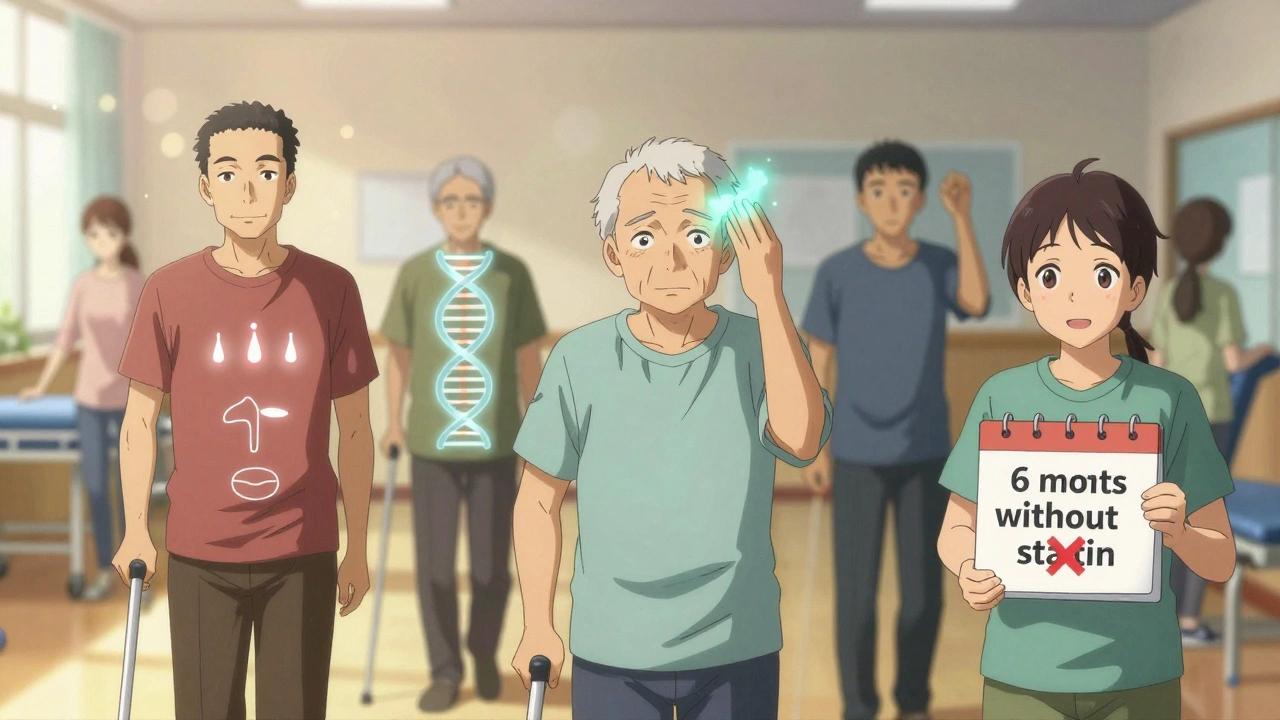
And here’s the biggest problem: people stop taking them. The REGARDS study found that nearly half of stroke survivors weren’t even prescribed a statin when they left the hospital. Of those who were, about 30% quit within six months. The reasons? Muscle pain, stomach upset, fear of side effects, or just forgetting. But stopping statins after a stroke is dangerous. A 2023 study showed that people who quit within six months had a 42% higher chance of having another stroke. That’s not a small risk. It’s the difference between living independently and needing long-term care.
What to Do If You Can’t Tolerate High Doses
You don’t have to take 80 mg of atorvastatin to get protection. Many patients do better on lower doses-like 40 mg-or switch to rosuvastatin, which is often better tolerated. Some doctors even prescribe statins every other day instead of daily. That can cut side effects without losing much benefit. The key is not to quit cold turkey. Talk to your doctor. There’s almost always a way to keep some level of statin therapy going.
One patient I spoke with-let’s call her Linda-had a stroke at 62. She was put on atorvastatin 80 mg and developed severe leg cramps within weeks. She wanted to stop. Her neurologist didn’t push her. Instead, they switched her to rosuvastatin 20 mg. Her muscle pain faded. Her LDL dropped from 140 to 58. She’s been on it for two years with no issues. She says the only thing that kept her going was knowing that stopping meant risking another stroke.
How Doctors Decide Who Gets High-Dose Statins
It’s not just about your cholesterol number. Doctors look at your whole picture. Did your stroke come from a blocked artery? Are you diabetic? Do you have high blood pressure? Have you had a brain bleed before? Are you on other meds that interact with statins? All of that matters.
Before starting high-dose statins, most doctors will order a blood test to check your liver enzymes and a muscle enzyme called CK. They’ll repeat it in 3 to 6 months. If you’re over 75, have kidney disease, or are taking certain antibiotics or antifungals, they might start lower. If you’re younger, otherwise healthy, and had an atherosclerotic stroke, they’ll likely push for intensive therapy.
Some hospitals now use computer alerts to remind doctors to prescribe statins at discharge. The Get With The Guidelines-Stroke program found that using these tools boosted statin prescriptions by 15 to 20 percentage points. That’s huge. Too many people still leave the hospital without this critical medication.
New Research and What’s Coming Next
A 2024 study in JAMA Neurology looked at whether starting statins right after stroke-within 72 hours-helps recovery. The answer? It didn’t reduce the chance of another stroke in the first 90 days. But it did slightly improve how well people moved and spoke afterward. That’s promising. It suggests statins might help the brain heal, not just prevent clots.
Right now, a major trial called STROKE-STATIN is enrolling 1,200 patients to see if starting statins immediately after stroke leads to better long-term function. Results are expected by late 2024. If they show clear benefits, we might see even more aggressive timing of treatment.
Also on the horizon: genetic testing. Some people have a gene variant (SLCO1B1) that makes them more likely to get muscle pain from statins. Testing for it is becoming cheaper and more available. In the future, your doctor might test your DNA before prescribing high-dose statins to predict who’s at risk.
Bottom Line: Don’t Quit Without Talking to Your Doctor
High-dose statins after stroke are not perfect. They carry risks. But for most people who’ve had an ischemic stroke, the benefits far outweigh them. The chance of another stroke is highest in the first year. Statins cut that risk. The key is finding the right dose for you-not the highest possible, but the highest you can tolerate.
If you’re on statins and feel side effects, don’t stop. Call your doctor. Try a lower dose. Switch brands. Change the timing. There are options. Quitting entirely? That’s the riskiest choice of all.
What You Can Do Today
- Know your LDL number. Ask your doctor what your target should be after stroke.
- If you’re not on a statin, ask why. Make sure your stroke type was considered.
- If you’re on one and feel side effects, don’t quit. Talk to your provider about alternatives.
- Get your liver and muscle enzymes checked every 3 to 6 months.
- Keep your blood pressure and diabetes under control. Statins work better when combined with other healthy habits.
After a stroke, every decision counts. Choosing to stay on statins-even at a lower dose-is one of the most powerful things you can do to protect your future.
Write a comment
Items marked with * are required.


10 Comments
Ben Greening December 11, 2025 AT 05:54
The SPARCL trial data is solid, but real-world adherence remains the elephant in the room. I’ve seen patients stop statins after minor muscle aches, unaware that the risk of recurrence far outweighs the discomfort. It’s not about pushing pills-it’s about helping people understand that prevention isn’t optional.
Doctors need to frame this not as a mandate, but as a partnership. A 40 mg dose isn’t failure-it’s strategy.
Nikki Smellie December 11, 2025 AT 21:25
Have you ever wondered why the pharmaceutical industry pushes high-dose statins so aggressively? The SPARCL trial was funded by Pfizer-same company that makes atorvastatin. Coincidence? I think not. The hemorrhagic stroke risk is buried in footnotes, while the 16% benefit is plastered on every brochure.
And don’t get me started on the liver enzyme warnings-those are just the tip of the iceberg. What about long-term cognitive decline? Studies are suppressed. You think your doctor knows the truth? They’re paid to prescribe.
Check your bloodwork. Then check your bank account. Who profits? 🤔
Michaux Hyatt December 11, 2025 AT 22:56
Hey everyone-just wanted to share a quick win. My mom had a stroke last year and was put on 80 mg atorvastatin. She got terrible cramps, so her doc switched her to rosuvastatin 10 mg every other day. Her LDL dropped to 62, no pain, and she’s been fine for 18 months.
Point is: you don’t need the max dose to get results. Talk to your provider. There’s almost always a middle ground. You’re not weak for needing a lower dose-you’re smart for listening to your body.
And if you’re scared to ask? Write down your questions before the appointment. I did. It changed everything.
Jack Appleby December 12, 2025 AT 05:21
It is both intellectually lazy and statistically naive to conflate the SPARCL trial’s 16% relative risk reduction with clinical significance. The absolute risk reduction was 2.2% over five years-barely a blip on the epidemiological radar.
Furthermore, the hemorrhagic stroke hazard ratio of 1.66 is not trivial; it is a clinically meaningful increase in a catastrophic event. The pleiotropic effects of statins are speculative at best, and the notion that they "help the brain heal" is pure post hoc rationalization.
Moreover, the REGARDS study’s 30% discontinuation rate is not evidence of patient ignorance-it is evidence of rational risk-benefit calculus. When the marginal benefit is negligible and the side effect profile is nontrivial, discontinuation is not abandonment-it is autonomy.
Let us not confuse pharmaceutical marketing with medical science.
David Palmer December 13, 2025 AT 07:50
statins are just a money grab. my uncle took them for a year and felt like a zombie. now he’s off them and doing fine. why are we even talking about this?
Doris Lee December 15, 2025 AT 00:10
Just want to say-you’re not alone if you’re scared or confused. I was too. My husband had a stroke and we were handed a script and told to take it. No one told us about the alternatives.
But when we talked to his neurologist, she didn’t judge. She just said, "Let’s find what works for you." We tried 40 mg, then every-other-day. He’s been on it for three years. No cramps. No brain bleeds. Just peace of mind.
You don’t have to be perfect. You just have to keep trying. And you deserve to feel safe in your own body.
Frank Nouwens December 15, 2025 AT 14:04
While the SPARCL trial remains a cornerstone of post-stroke lipid management, its generalizability is limited by its exclusion criteria: patients with recent hemorrhagic stroke, severe liver disease, and those on interacting medications were excluded.
Consequently, real-world applicability requires individualized risk stratification. The notion that all ischemic stroke patients should receive intensive statin therapy is an oversimplification of a complex clinical landscape.
Furthermore, the 2024 JAMA Neurology findings regarding early statin initiation and functional recovery warrant further prospective validation before altering current paradigms.
Queenie Chan December 15, 2025 AT 17:59
I’ve always thought about statins as a kind of molecular peacekeeper-calming the inflammatory fire inside arteries, not just scrubbing away cholesterol like a dirty dish.
But here’s the weird part: if inflammation is the real villain, why don’t we have better anti-inflammatory drugs for this? Statins are kind of a lucky accident, aren’t they? Like finding out your grandma’s herbal tea cured your headache because it had aspirin in it all along.
And now we’re talking about genetic testing before prescribing? That feels like science fiction becoming real. I wonder if, in 20 years, we’ll look back at this era and laugh at how we guessed dosages instead of reading our DNA like a recipe book.
Stephanie Maillet December 16, 2025 AT 06:23
There’s something deeply human here-not just about medicine, but about fear, control, and surrender.
We take statins not because we want to, but because we’re terrified of dying again. And yet, we’re terrified of the side effects, the unknowns, the way our bodies betray us even as we try to fix them.
Is it medicine, or is it a ritual? A daily act of faith in a system that doesn’t always know what it’s doing? Maybe that’s why so many stop-they’re not rejecting the drug; they’re rejecting the helplessness it represents.
And yet… the data says: stay. Not because it’s perfect-but because, in the shadow of stroke, perfection is a luxury we can’t afford.
So we take it. We adjust. We breathe. And we hope.
It’s not science. It’s survival.
And maybe that’s enough.
Kaitlynn nail December 17, 2025 AT 06:54
statins are just a bandaid on a broken system. we need better food, less stress, more sleep-not pills.