Health March 10, 2026
How Multiple Generic Drug Makers Drive Down Prices
Generic drug prices don’t drop because a company feels generous. They fall because someone else is selling the same pill for less-and then another, and another. When five, ten, or even twenty companies make the exact same medication, the price doesn’t just dip. It plummets. This isn’t theory. It’s math. And it’s saving millions of people thousands of dollars every year.
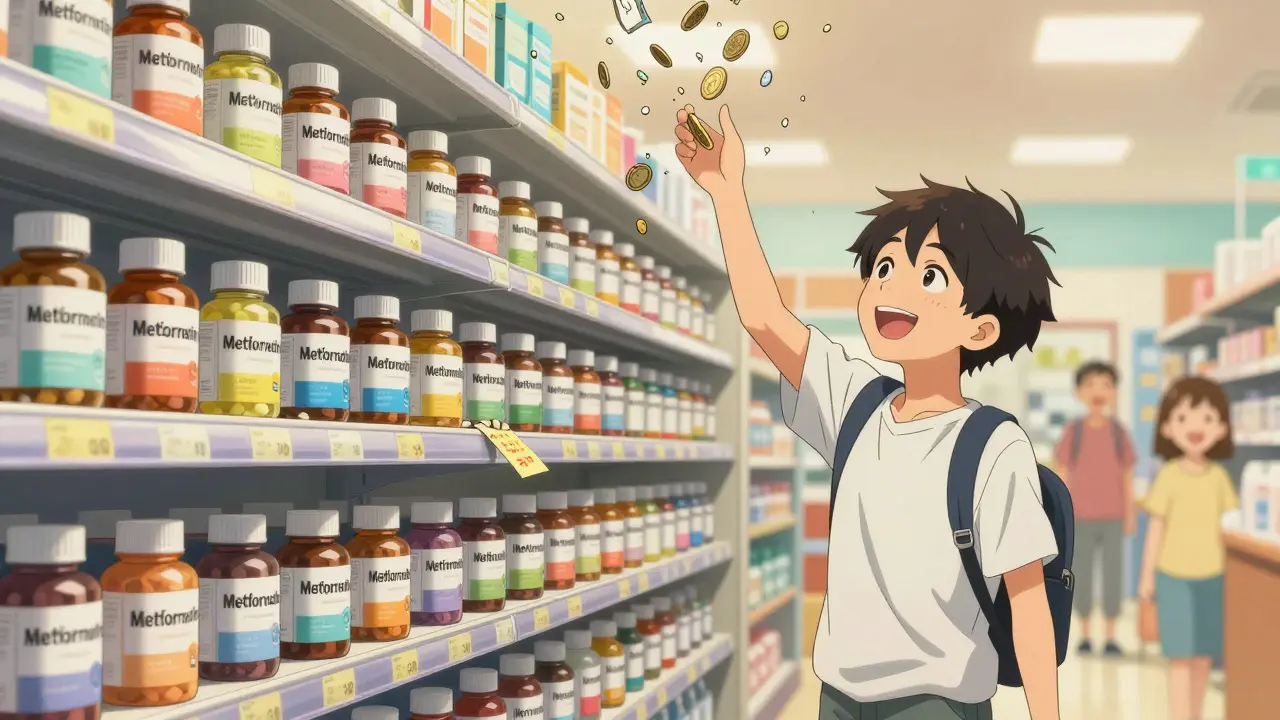
Take metformin, the most common diabetes drug in the U.S. In 2024, you could buy a 90-day supply for under $10 at many pharmacies. Why? Because at least eight different manufacturers make it. No single company controls the market. If one tries to raise prices, another steps in with a cheaper version. The result? A drug that once cost over $200 a month now costs less than a cup of coffee. That’s the power of competition.
How Many Competitors It Takes to Slash Prices
It’s not just about having a generic version. It’s about how many make it. A 2021 study from the University of Southern California tracked 50 brand-name drugs after their patents expired. The numbers tell the story:
- One generic manufacturer? Price drops just 17%.
- Two manufacturers? Down 39.5%.
- Three manufacturers? Down 52.5%.
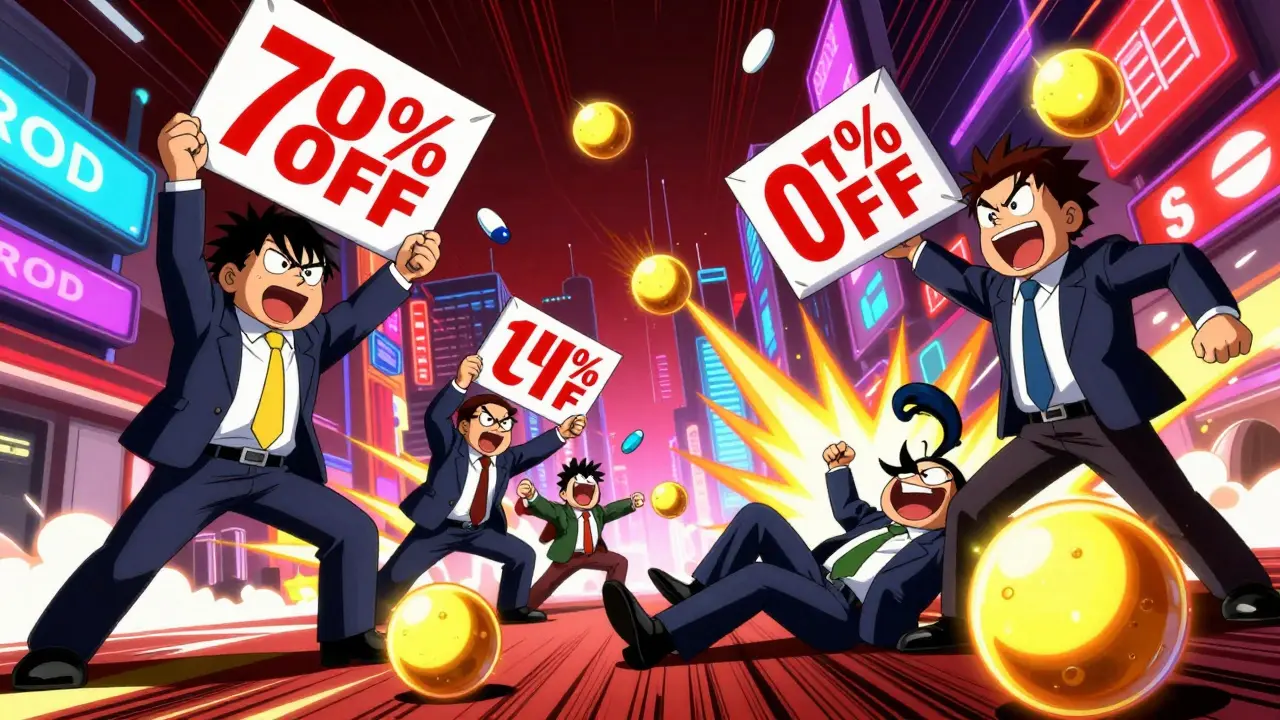
- Four or more? Prices fall by over 70%.
That’s not a coincidence. Each new entrant forces everyone else to lower prices just to stay in the game. The biggest drops happen between the first and third competitors. After that, prices keep falling-but more slowly. Still, when ten companies make the same drug, prices often drop to 70-80% below what the brand-name version charged.
Compare that to a drug with only one or two generic makers. Those prices barely move. In some cases, they even rise. Why? Because there’s no pressure to compete. A 2017 study found that over half of all generic drugs in the U.S. have at most two manufacturers. That’s not competition. That’s a cozy oligopoly.
Why Some Drugs Stay Expensive
Not all generics work the same way. Oral pills-like antibiotics, blood pressure meds, or antidepressants-are easy to copy. The chemistry is simple. The manufacturing is straightforward. That’s why drugs like amoxicillin, lisinopril, or sertraline have dozens of makers and cost pennies.
But injectables, infusions, and complex biologics? Those are different. They’re harder to replicate. Fewer companies can make them. Even when biosimilars (the generic version of biologics) enter the market, they rarely drive prices down like simple generics do. One study found that if biosimilars were treated like regular generics under Medicare, spending on those drugs would’ve dropped nearly 27% between 2015 and 2019. But they weren’t. So prices stayed high.
And then there’s the supply chain. A drug might have five manufacturers, but if three of them are owned by the same parent company, it’s still effectively one player. That’s why mergers between small generic makers are so dangerous. Between 2014 and 2016, nearly 100 of these companies were bought up. The result? Fewer competitors. Higher prices. And patients caught in the middle.
What Happens When Competition Disappears
When a drug has only one or two makers, things get risky. If one company stops production-because of a factory issue, regulatory problem, or just because it’s not profitable anymore-the other one can raise prices overnight. No one else is left to step in.
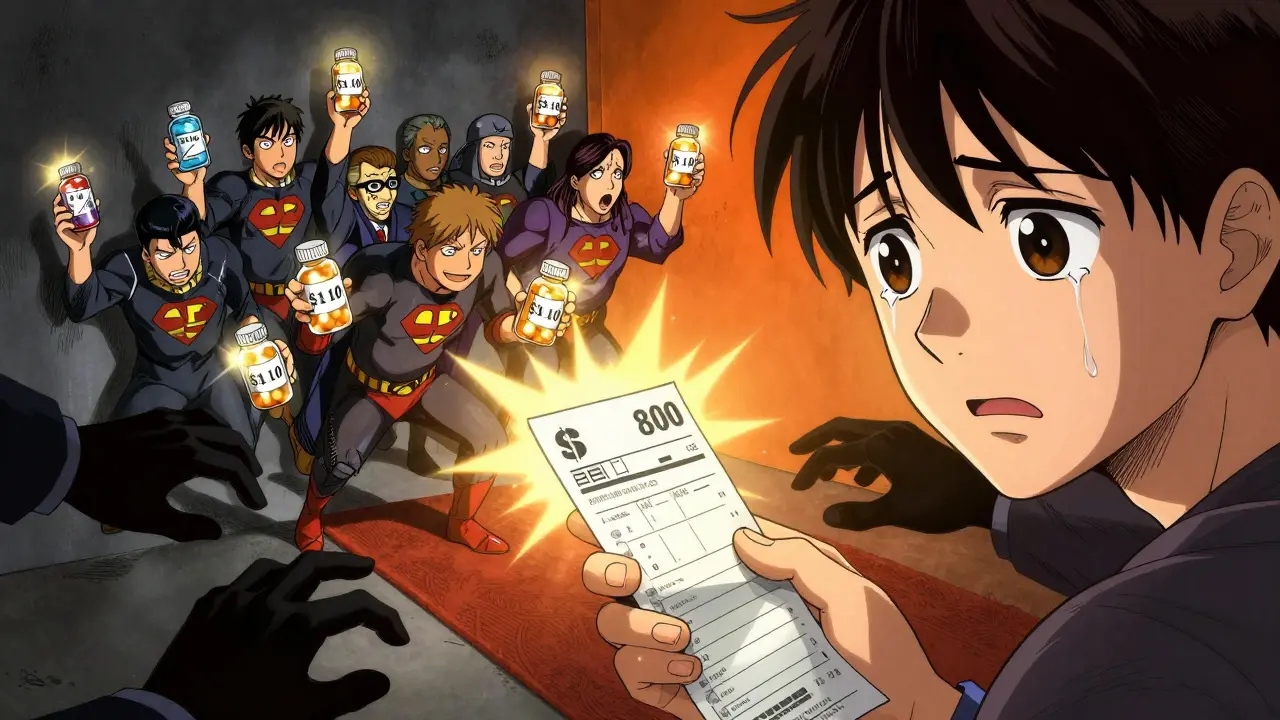
Patients have reported price spikes of 300% to 500% for drugs like levetiracetam (used for epilepsy) or phenytoin (for seizures) after manufacturers left the market. One Reddit user in 2023 described paying $800 for a 30-day supply of a drug that used to cost $40. That’s not a pricing mistake. That’s market failure.
And it’s not just about cost. When manufacturers cut corners to stay profitable, quality suffers. Indiana University researchers found that price pressure in the generic market can lead to shortages-and worse, safety risks. A single plant failure can mean no drug at all for thousands of patients.
The Hidden Role of Pharmacy Benefit Managers
You might think PBMs (Pharmacy Benefit Managers) help lower prices. But their role is complicated. They negotiate bulk deals with drugmakers and pharmacies. In theory, that should cut costs. In practice, they often favor manufacturers that offer the biggest rebates-not the lowest prices.
That means a slightly more expensive drug might get priority on insurance formularies because it gives the PBM a bigger cut. The patient still pays the same out-of-pocket, but the real savings get buried in corporate deals. The FDA and FTC have both flagged this as a problem. Without transparency, it’s hard to know if you’re getting the cheapest option-or just the one that pays the middleman the most.
How to Use Competition to Save Money
You don’t need a degree in economics to use this system to your advantage. Here’s how:
- Check the generic name. Your doctor might prescribe a brand name, but ask if a generic is available. Almost always, it is.
- Use price comparison tools. GoodRx, SingleCare, and even your pharmacy’s website show prices across local pharmacies. The same drug can cost $5 at one store and $40 at another.
- Ask about therapeutic equivalence. The FDA’s Orange Book lists which generics are interchangeable with the brand. Look for an “AB” rating. That means it’s identical in effectiveness.
- Don’t assume your pharmacy’s choice is cheapest. Pharmacists can substitute generics, but sometimes they pick one based on inventory-not price. Ask them to check.
- Buy in bulk. Many generics are cheaper at 90-day supplies. Especially for chronic conditions like diabetes or high blood pressure.
For example, a 90-day supply of generic atorvastatin (Lipitor) might cost $12 at Walmart, $28 at CVS, and $18 at Target. A two-minute search saves you $16 a month. That’s $192 a year. On a fixed income, that matters.
What’s Changing Now
The FDA’s Drug Competition Action Plan, launched in 2017, is trying to fix the broken parts of this system. It’s speeding up approvals for generics and cracking down on tactics brand-name companies use to delay competition-like paying generic makers to stay out of the market.
The CREATES Act of 2019 made it illegal for brand companies to block access to samples needed for generic testing. That’s a big win. But enforcement is still weak. And mergers keep slipping through federal review.
The good news? In 2022 alone, 742 new generic drugs were approved by the FDA. They’re projected to save the U.S. healthcare system $14.5 billion this year. That’s real money. Real relief.
The bad news? The trend is still toward fewer competitors. Small manufacturers are being swallowed by bigger ones. And the system isn’t designed to stop it.
What’s clear? Competition works. When multiple companies make the same drug, prices fall. When only one or two do, they rise. Patients don’t need more regulation. They need more competitors.
Next time you fill a prescription, ask: How many other companies make this? If the answer is fewer than three, you might be paying more than you need to. And that’s not just your problem. It’s a system failure.
Why do some generic drugs cost more than others?
It’s not about quality-it’s about competition. If only one or two companies make a generic drug, they don’t have to lower prices. But if ten companies make it, they fight to win business by cutting costs. That’s why metformin costs $10 and some other generics cost $100. Same drug, different number of makers.
Can I ask my pharmacist to switch to a cheaper generic?
Yes. In all 50 states, pharmacists can substitute a generic for a brand-name drug unless your doctor says "dispense as written." You can also ask them to check which generic version is cheapest at your pharmacy. Many times, the difference is just a few dollars-but over time, it adds up.
Are all generic drugs the same as brand-name ones?
For most drugs, yes. The FDA requires generics to have the same active ingredient, strength, dosage form, and route of administration as the brand. They must also meet the same strict quality standards. The only differences are inactive ingredients like fillers or colorings, which don’t affect how the drug works. Look for an "AB" rating in the FDA’s Orange Book to confirm therapeutic equivalence.
Why don’t drug prices drop immediately after a generic comes out?
It takes time for competitors to enter. The first generic usually arrives 6-12 months after patent expiry. Then it takes another year or two for others to join. Prices fall fastest between the first and third competitors. After that, the rate slows, but they keep dropping. By year three, prices are often 60-80% lower than the original brand.
What should I do if my generic drug suddenly gets much more expensive?
Check if your drug has only one or two manufacturers. If so, it’s likely due to a shortage or market consolidation. Use GoodRx or ask your pharmacist for alternatives. Sometimes, switching to another generic version-even if it’s a different brand name-can cut costs dramatically. Also, notify your doctor. They may be able to prescribe a similar drug with more competition.
Write a comment
Items marked with * are required.

15 Comments
Denise Jordan March 10, 2026 AT 15:36
I swear, I asked my pharmacist for the cheapest metformin and she gave me the one that costs $12. Then I checked GoodRx and it was $8 at a different store. I didn’t even try. I just took what was handed to me. Guess who’s paying for that laziness? Me. Again.
Kenneth Zieden-Weber March 11, 2026 AT 05:09
Oh wow, so competition = cheap drugs? Groundbreaking. Next you’ll tell me water is wet and gravity exists. Meanwhile, the same people who cheer for ‘free market magic’ when it lowers insulin prices are the ones who scream ‘regulation!’ when a single mom can’t afford her blood pressure med. Funny how that works.
Chris Bird March 12, 2026 AT 10:49
In Nigeria, we don't have this problem. We have one generic. And it cost $50. No competition. No choice. Just pray the drug don't expire before you get to the clinic.
Bridgette Pulliam March 14, 2026 AT 01:53
I appreciate the data. Really. But I’ve been on the same generic for 8 years. The price went from $15 to $22 over 2 years. Then dropped to $8 after a new manufacturer entered. I didn’t know why until now. This makes sense. Thank you.
Mike Winter March 14, 2026 AT 13:39
I wonder... if we treated drug manufacturing like public infrastructure-like roads or water systems-would we see more stability? Not because we’re socialists, but because medicine isn’t a luxury. It’s a biological necessity. The market doesn’t optimize for survival. It optimizes for profit. And that’s a flaw in the system, not a feature.
Randall Walker March 15, 2026 AT 02:54
I mean... seriously? You have to google your own prescription? Like, what the actual f. Why is this even a thing? I go to the pharmacy and they hand me a pill. I don’t have time to play price detective. I’m tired. I’m sick. I just want the damn thing to work.
LiV Beau March 16, 2026 AT 17:38
OMG YES! 😍 I used to pay $40 for my generic sertraline. Then I found out there were 7 different versions. I switched to the one at Costco. Now it’s $7. I feel like I won the lottery. Also, my cat is happy. She doesn’t have to hear me cry about bills anymore. 🐱💖
Adam Kleinberg March 18, 2026 AT 16:40
This is all just a psyop. The FDA, Big Pharma, and the PBM cabal are letting just enough competition in to make people think the system works. Meanwhile, they’re quietly consolidating patents under shell corporations. Mark my words: in 5 years, there’ll be ONE maker left. And it’ll be owned by a private equity firm that doesn’t even make pills. They just own the license.
Gene Forte March 18, 2026 AT 20:47
Let’s remember: competition isn’t magic. It’s just math. More suppliers = lower prices. Simple. But we’ve built a system that rewards consolidation. We need to flip the script. Encourage new entrants. Protect small manufacturers. Reward transparency. It’s not complicated. It’s just not profitable for the big guys.
David L. Thomas March 20, 2026 AT 05:29
The real bottleneck isn’t manufacturing-it’s regulatory latency. The FDA approval pipeline for generics is a maze. And the first-mover advantage? It’s not about price. It’s about who gets the formulary slot. That’s where the real power lies. The rest is noise.
Miranda Varn-Harper March 21, 2026 AT 01:52
I’m sorry, but if you’re relying on GoodRx to afford your medication, you’ve already lost. This isn’t a personal finance tip. It’s a systemic failure. You shouldn’t need to be a price detective just to stay alive. That’s not freedom. That’s survival mode.
Alexander Erb March 23, 2026 AT 00:46
I used to think generics were sketchy. Then my mom got on one for her blood pressure. Same pill. Same effect. Saved her $200/month. I’m now a full-on generic evangelist. If you’re not checking prices? You’re leaving money on the table. And honestly? That’s just dumb.
Donnie DeMarco March 24, 2026 AT 05:52
Bro, imagine if your Netflix password was $100 a month and you had to haggle with 12 different providers to get the cheapest one. That’s our healthcare. We’re not patients. We’re price-obsessed shoppers with anxiety disorders. And the system loves it.
Tom Bolt March 26, 2026 AT 02:24
I just found out my 90-day supply of levetiracetam went from $45 to $800 last month. I called my pharmacy. They said ‘oh, the manufacturer stopped production.’ I asked if they had another version. They said ‘we do, but it’s not on our formulary.’ So I’m paying $800 for a pill that costs $12 elsewhere. This isn’t capitalism. It’s a horror movie.
Shourya Tanay March 27, 2026 AT 22:39
In India, we have 30+ manufacturers for metformin. Prices are absurdly low. But we also have terrible quality control. Some generics are underdosed. Others have contaminants. So yes, competition lowers price-but it doesn’t guarantee safety. We need both. Not one or the other.