Health December 2, 2025
How to Prevent Accidental Medication Poisoning in Kids and Toddlers
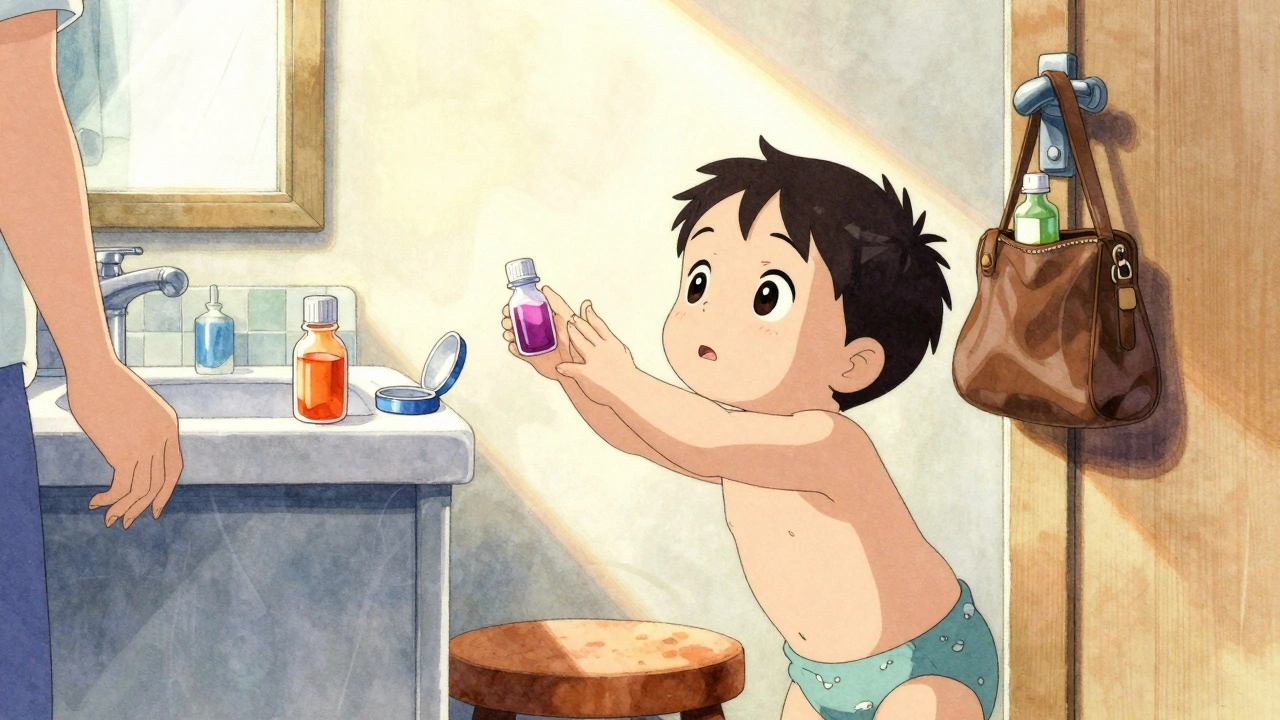
Every year, more than 90 percent of accidental medication poisonings in children happen right at home - often while a parent or caregiver is nearby. It’s not a matter of neglect. It’s a matter of oversight. A pill left on a nightstand. A bottle in a purse. A teaspoon used to measure liquid medicine. These aren’t big mistakes. They’re tiny, common moments that can turn deadly in seconds. And the most vulnerable? Kids between 1 and 5 years old. They’re curious, fast climbers, and they don’t understand danger. They see a colorful liquid and think it’s juice. They see a round pill and think it’s candy.
Why Kids Get Into Medicine
| Medication Type | Common Examples | Risk Level |
|---|---|---|
| Analgesics | Acetaminophen (Tylenol), Ibuprofen (Motrin, Advil) | High |
| Antihistamines | Diphenhydramine (Benadryl) | High |
| Nicotine (e-liquids) | E-cigarette cartridges, vape pens | Extreme |
| Aspirin | Various OTC brands | High |
| Prescription meds | Antidepressants, blood pressure pills | Very High |
Children don’t go looking for poison. They find it. A toddler sees a bottle on the counter while you’re washing dishes. A 2-year-old climbs onto the toilet to reach a purse hanging on the back of the bathroom door. A grandparent leaves their medication on the bedside table during a visit. These aren’t rare events - they’re routine. In fact, 30 percent of poisonings come from medicines left in visitors’ belongings. And 25 percent happen because the medicine was moved from its original container into a different bottle or pill organizer.
Locked Storage Is Not Optional
| Practice | Why It Matters | Real-World Impact |
|---|---|---|
| Use locked cabinets with automatic latches | Children can climb on chairs, counters, and toilets | Reduces access by over 80% |
| Store meds 54+ inches above floor | Toddlers can reach up to 4 feet | 78% of incidents occur below this height |
| Never store in purses, bags, or coat pockets | Visitors leave meds unattended | 30% of poisonings from visitor belongings |
| Keep all meds in original containers | Transfer increases confusion and risk | 25% of incidents involve non-original containers |
| Use magnetic or key-lock cabinets | Child-resistant caps are not childproof | Only 1 in 5 kids can’t open them |
Child-resistant caps? They’re not enough. A study by the American Academy of Pediatrics found that one in five toddlers can open them within minutes. That’s why you need more than a cap - you need a lock. Install cabinets with automatic latches that click shut when closed. Magnetic locks that require a key or code are even better. Don’t just put meds on a high shelf. Get on your hands and knees. Look around your home from your child’s eye level. What do you see? A medicine bottle on the bathroom counter? A pill bottle in the kitchen junk drawer? A bottle of liquid Tylenol next to the juice? That’s not storage - that’s an invitation.
Never Call Medicine “Candy”
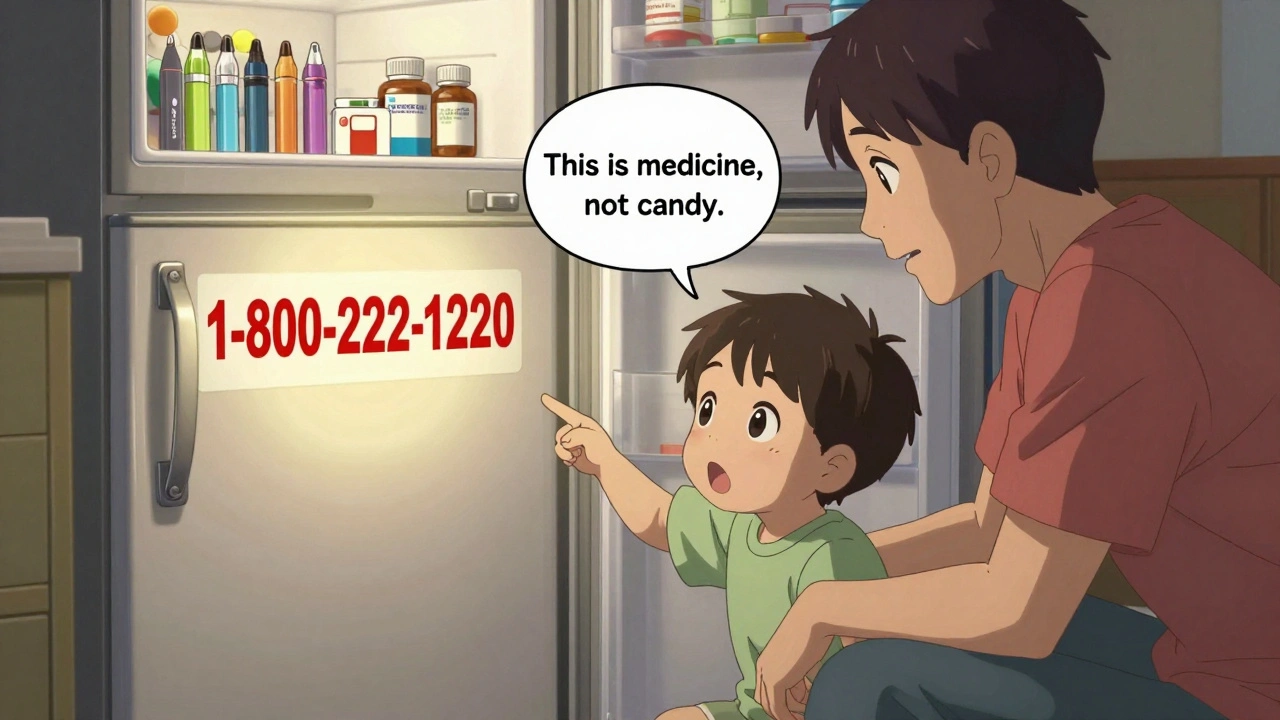
It’s tempting. You want to make taking medicine easier. So you say, “This is like candy, sweetie.” But research shows that kids who are told medicine tastes like candy are 3.2 times more likely to take it without asking. That’s not a small risk. That’s a life-or-death mistake. Even if you say it with a smile, your child hears: “This is something fun to eat.” And they’ll remember that. Don’t say “yummy.” Don’t say “treat.” Don’t say “good for you.” Just say: “This is medicine. It helps you feel better, but you can’t have it unless I give it to you.”
Measuring Medicine Correctly
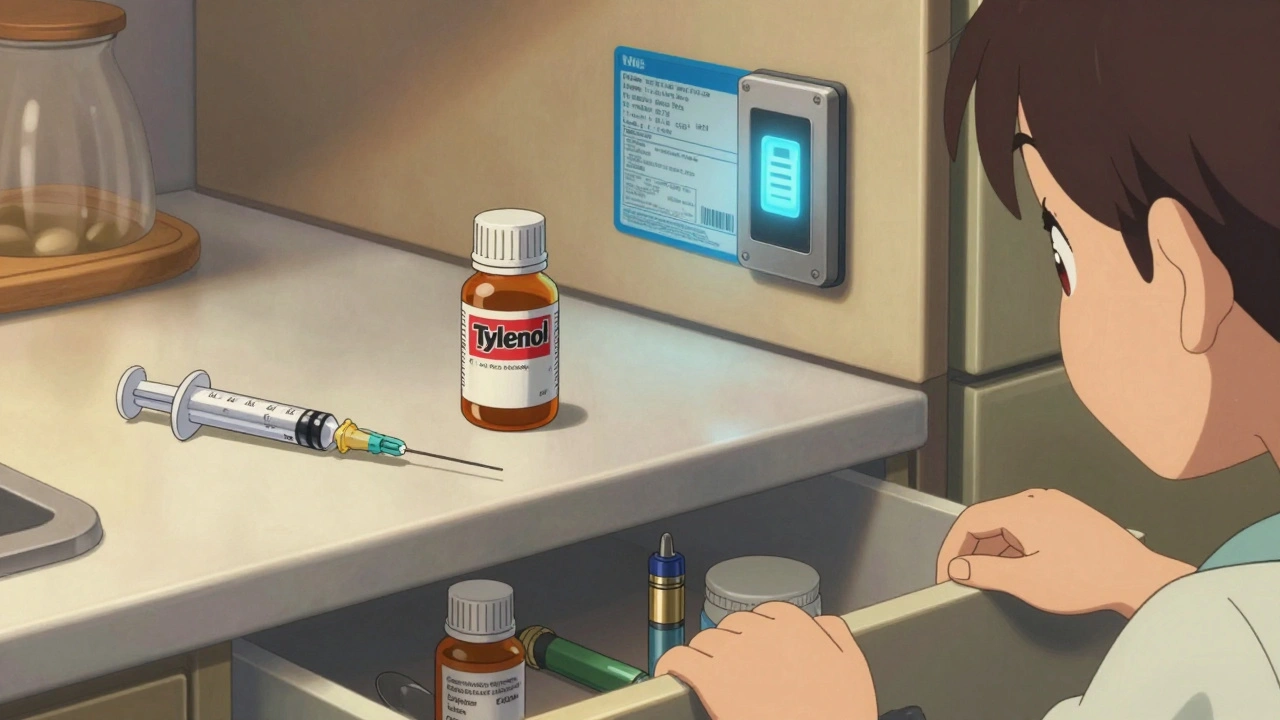
Most parents don’t realize that a kitchen teaspoon isn’t a teaspoon. A regular spoon holds anywhere from 3 to 7 milliliters - but medicine dosing is precise. The difference between 5 mL and 7 mL might seem small, but for a toddler, it can mean the difference between a safe dose and an overdose. In fact, 42 percent of dosing errors involve using kitchen spoons. Always use the measuring tool that comes with the medicine - a syringe, a dosing cup, or a dropper with clear milliliter markings. Never guess. Never estimate. Never use a regular spoon.
High-Risk Situations You Can’t Ignore
Most poisonings happen when you’re distracted. You’re pouring medicine into a cup. You turn your back to answer the door. You’re on the phone. You leave the bottle on the counter. In 40 percent of cases, the parent was actively using the medicine when the child got to it. That’s why you must never leave medicine unattended - not even for 10 seconds. Put it away before you walk away. Even if you’re just stepping into the next room.
Grandparents visiting? That’s a major risk. Households with visiting elders have a 35 percent higher chance of a poisoning incident. Why? Because grandparents often leave their own medications in purses, nightstands, or coat pockets - places a child can reach. Make a rule: all visitors’ meds go into the locked cabinet too. Even if they’re “just here for an hour.”
And don’t forget about nicotine. Liquid from e-cigarettes is incredibly dangerous. As little as 0.5 mL - half a teaspoon - can kill a toddler. Store vape pens and cartridges in the same locked cabinet as your medicine. Don’t assume they’re safe just because they’re “not drugs.” They’re poison.
When Accidents Happen
Even the most careful households have accidents. That’s why every home with kids needs two things: a visible phone number and a plan.
Post the Poison Help number - 1-800-222-1222 - on the fridge, next to the phone, on the bathroom mirror. Don’t rely on memory. In homes where the number is posted, emergency response time drops by 47 percent. And if you suspect your child swallowed something, don’t wait. Don’t call your pediatrician first. Don’t Google it. Call Poison Control immediately. The sooner you call, the better the outcome. If you call within five minutes, your child’s chance of avoiding serious harm goes up by 89 percent.
Also, keep CPR and Heimlich maneuver training up to date. In 12 percent of severe cases, life-saving action is needed before paramedics arrive. You don’t need to be a doctor. You just need to know what to do.
What Works - Real Programs That Save Lives
Some communities are already making progress. Pharmacies in certain states now give out free medication lock boxes to families with toddlers. In those homes, accidental access dropped by 41 percent. Schools running the “Over-the-Counter Medicine Safety” program saw a 28 percent drop in misuse among kids - not because children stopped being curious, but because they learned to ask before touching.
And there’s a new tool on the horizon: smart medicine containers. These devices track when a dose is taken and send alerts to your phone if someone opens the bottle without permission. Pilot programs showed a 63 percent reduction in unsupervised access. These aren’t science fiction - they’re coming soon.
Final Checklist: Your Home, Your Safety
- Lock all medications in cabinets - not just high shelves.
- Keep meds in original containers with child-resistant caps.
- Never leave medicine out while using it - even for a second.
- Store all visitors’ meds in the same locked cabinet.
- Use only the measuring tool that came with the medicine.
- Never call medicine “candy” or “treat.”
- Post 1-800-222-1222 in every room.
- Check your home from your child’s eye level - get down on the floor.
- Store e-cigarettes and nicotine liquids like poison - because they are.
- Learn CPR and the Heimlich maneuver for children.
Accidental poisoning isn’t a matter of bad parenting. It’s a matter of environment. You can’t stop a child from being curious. But you can stop them from reaching the poison. It’s not about being perfect. It’s about being prepared.
Can child-resistant caps alone prevent poisoning?
No. Child-resistant caps are designed to slow down adults, not children. Studies show that one in five toddlers can open them within minutes. They’re a backup - not a solution. Always use locked cabinets in addition to child-resistant caps.
What should I do if my child swallows medicine?
Call Poison Control immediately at 1-800-222-1222. Don’t wait for symptoms. Don’t try to make your child vomit. Don’t give milk or food unless instructed. Have the medicine container ready when you call - they’ll need the name, strength, and amount taken.
Is it safe to store medicine in the bathroom?
No. Bathrooms are humid, which can degrade medicine, and they’re full of accessible places - counters, cabinets, toothbrush holders, purses on hooks. Always store medicine in a cool, dry place - like a locked cabinet in a bedroom or kitchen.
Why are toddlers more at risk than older kids?
Toddlers (1-5 years) are more mobile, more curious, and less able to understand danger. They can climb, open cabinets, and reach high shelves. They also explore the world by putting things in their mouths. By age 6, most kids understand that medicine isn’t food - but toddlers don’t.
Are there free resources for lock boxes or safety tools?
Yes. Many pharmacies, hospitals, and public health programs offer free medication lock boxes to families with young children. Check with your pediatrician, local pharmacy, or county health department. Some programs also provide free safety latches and measuring tools.
What time of day are poisonings most common?
Between 12 p.m. and 6 p.m. - not at night. That’s when parents are busy with meals, playtime, or errands and may be distracted. It’s a myth that nighttime is the most dangerous time. Stay alert during the afternoon hours.
What’s Next?
Start today. Lock one cabinet. Post the Poison Control number. Throw away old or unused meds at a take-back site. Talk to your child’s daycare or school about their safety policies. Small steps add up. You don’t need to fix everything at once. Just make one change - and then another. Your child’s safety isn’t about perfection. It’s about consistency.
Write a comment
Items marked with * are required.


11 Comments
parth pandya December 2, 2025 AT 20:58
Man i read this and thought about my cousin’s kid who got into his grandpa’s blood pressure pills last year. Scary stuff. I always thought childproof caps were enough, but turns out even my 3yo could open one in like 2 minutes. Learned my lesson the hard way. Now everything’s locked in a cabinet under the sink with a magnetic key. No more excuses.
Albert Essel December 3, 2025 AT 16:29
This is one of the most thorough, well-researched pieces on pediatric medication safety I’ve ever read. The data is clear, the tone is urgent without being alarmist, and the actionable steps are practical. Especially important is the point about not calling medicine ‘candy’ - that’s a cultural habit many parents don’t even realize they’re reinforcing. Thank you for writing this.
Rashi Taliyan December 4, 2025 AT 02:03
OH MY GOD I JUST REALIZED I LEFT MY BLOOD SUGAR TEST STRIPS ON THE KITCHEN COUNTER THIS MORNING 😭 I’M SO GLAD I READ THIS. I’M GOING TO LOCK EVERYTHING UP RIGHT NOW. I’M CRYING BECAUSE I COULD’VE LOST MY BABY. THANK YOU FOR THIS. I’M TELLING EVERYONE.
Cindy Lopez December 5, 2025 AT 22:23
So we’re supposed to lock up medicine like it’s cocaine now? I mean, I get it, but this feels like overkill. My kids are 3 and 5, and they’ve never even touched a pill. Maybe just supervise better instead of turning your house into a fortress?
Francine Phillips December 7, 2025 AT 00:08
Yeah but like… do we really need a whole checklist? I mean I just keep my meds in the bathroom cabinet and that’s fine
Katherine Gianelli December 8, 2025 AT 05:37
Y’all are so right to stress the ‘candy’ thing - I used to say ‘this is yummy medicine’ to my daughter and now I cringe every time I think about it. She’s 7 now and still asks if the vitamin gummies are candy. I had to retrain her. Also - get those free lock boxes from your pharmacy. My local CVS gave me one for free and it’s been a game changer. No more panic when I turn around and the bottle’s gone.
Joykrishna Banerjee December 9, 2025 AT 03:17
Let’s be honest - this is just another liberal nanny-state panic piece wrapped in pediatric jargon. Child-resistant caps are sufficient for 95% of cases. The real issue is parental negligence, not the medicine. And why are we treating nicotine vapes like they’re equivalent to fentanyl? That’s hyperbolic. Also, ‘magnetic lock cabinets’? Sounds like a Silicon Valley startup selling overpriced solutions to non-problems. 🤦♂️
Myson Jones December 9, 2025 AT 18:21
I appreciate the intent behind this. But I think we’re missing the bigger picture - many families can’t afford locked cabinets, or live in small apartments with no storage space. The advice is great, but it assumes a level of privilege not everyone has. Maybe we should be pushing for subsidized lock boxes or public health campaigns in low-income housing? Just a thought.
Charles Moore December 10, 2025 AT 13:01
My mom used to leave her pills on the nightstand when she visited. I didn’t think twice about it until my niece climbed up and swallowed half a bottle of her blood pressure med. We were lucky she got to the hospital fast. Now? All meds - even visitors’ - go in the locked drawer. No exceptions. It’s not about being paranoid. It’s about being responsible. And honestly? It’s way easier than dealing with an ER visit.
Kara Bysterbusch December 12, 2025 AT 09:44
As someone who grew up in a household where medicine was stored in a drawer next to the cookies, I can say this article changed my life. I now have a dedicated, locked, labeled medicine cabinet in my kitchen - with a small sign that says ‘MEDICINE: NOT FOOD’ in both English and Spanish, since my neighbors are mostly bilingual. I even gave one of these cabinets to my sister-in-law in Mexico City. Safety doesn’t have borders. 🌍💙
Rashmin Patel December 14, 2025 AT 08:00
Guys I just bought a smart medicine box with an app that texts me if someone opens it and I’m not home!! It cost like $40 but it’s worth it!! My toddler is 2 and she’s a ninja - she got into my ibuprofen last week and I almost had a heart attack. Now I get alerts on my phone like ‘Hey someone opened the medicine box at 3:17 PM’ and I know to check. Also I put stickers on the cabinet that say ‘Danger: Not Candy’ and she actually points at them now and says ‘no no’ 😭 This is the future y’all. We’re not just parents anymore - we’re tech-savvy guardians with apps and magnetic locks and zero chill. 🤖💊 #MedSafetyRevolution