Health March 17, 2026
Medication-Related Liver Damage: Signs You Can't Ignore and When to Act
Medication Safety Checker
Medication Safety Checker
Check if your medications or supplements may cause liver damage, with risk assessment and key information about timing and symptoms.
Safety Assessment
Key Information
Recommended Actions
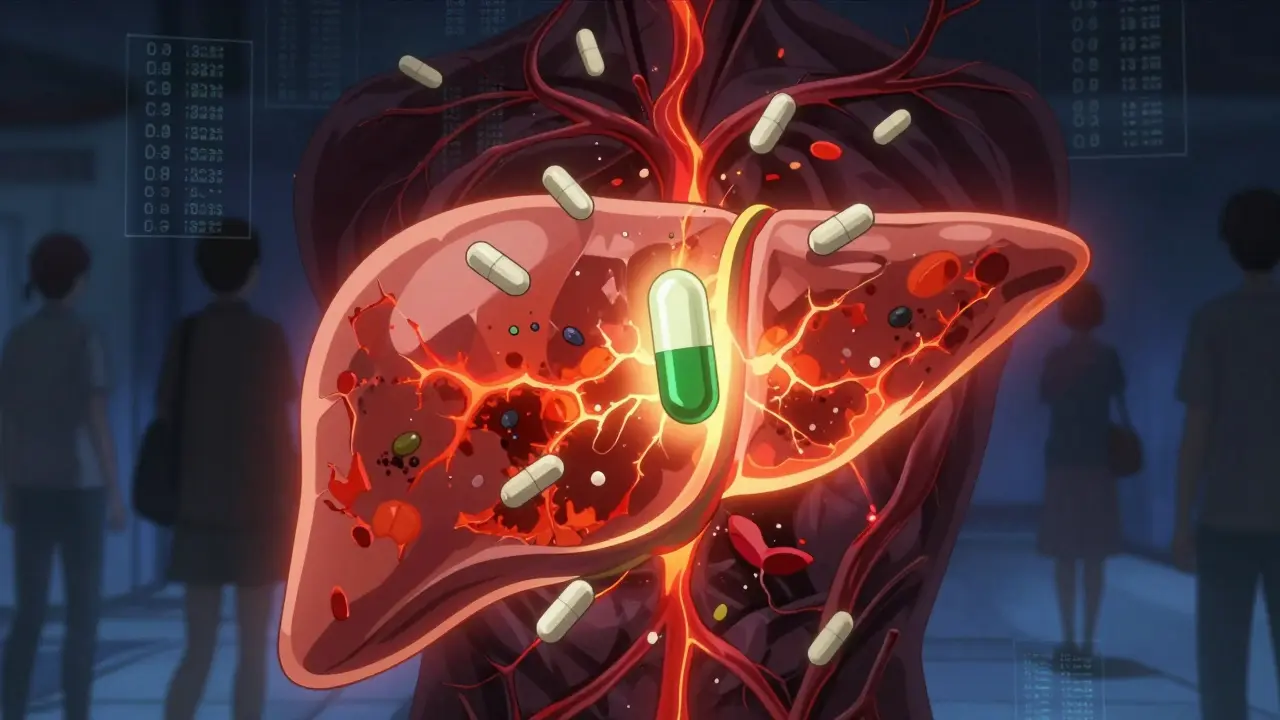
Most people don’t think about their liver until something goes wrong. But every pill you take - whether it’s a prescription, an over-the-counter painkiller, or that herbal supplement you bought online - passes through it. Your liver works hard to filter toxins, and sometimes, the very things meant to help you can hurt it. Medication-related liver damage, also called drug-induced liver injury (DILI), isn’t rare. It’s one of the top causes of acute liver failure in the UK and the US, and it’s often missed until it’s too late.
What Exactly Is Medication-Related Liver Damage?
DILI happens when a drug or supplement damages liver cells. It’s not the same as hepatitis from a virus. This damage comes from chemicals in medicines that the liver can’t process safely. Some drugs are known offenders: antibiotics like amoxicillin-clavulanate, anticonvulsants like valproate, and NSAIDs like ibuprofen. But surprisingly, herbal supplements are now responsible for 20% of DILI cases in the UK, with green tea extract alone causing nearly 40% of those cases, according to the British Liver Trust.
The scary part? You might not feel anything at first. Liver damage doesn’t always come with warning signs. By the time you notice symptoms, your liver enzymes could already be five, ten, even fifteen times higher than normal. That’s not a minor fluctuation - it’s a red alert.
The Three Main Patterns of Liver Damage
Not all liver damage looks the same. Doctors classify it into three patterns based on blood test results:
- Hepatocellular injury: This is when liver cells die. It shows up as ALT (alanine aminotransferase) levels above 5 times the normal limit. Think of it like a fire inside the liver. Isoniazid, used for tuberculosis, often causes this - ALT can spike past 1,000 IU/L.
- Cholestatic injury: This blocks bile flow. Alkaline phosphatase and GGT levels rise sharply. Amoxicillin-clavulanate is the usual suspect here. You might not feel sick, but your skin turns yellow, and your pee gets dark.
- Mixed pattern: A mix of both. This is common with many supplements and some painkillers. It’s harder to diagnose because it doesn’t fit neatly into one box.
These aren’t just numbers on a lab report. They’re clues. And if you’re taking a new medication and your blood work shows one of these patterns, it’s time to pause and investigate.
When Do Symptoms Show Up? Timing Matters
There’s no one-size-fits-all timeline. Some drugs hurt your liver fast. Others take weeks or months.
- Antibiotics: Usually within 1 to 8 weeks. The average? Around 15 days.
- Anticonvulsants: Slower. Often 45 days or more.
- Herbal supplements: The wild card. Could be 1 day or 365 days. One person gets sick after a week of turmeric. Another doesn’t notice until after 6 months of green tea extract.
- Acetaminophen (paracetamol): This is the exception. Overdose? Liver damage can show up in 24 hours. Peak damage hits at 72 hours. If you take too much, every hour counts.
That’s why it’s so easy to miss. If you started a new supplement 3 months ago and now feel tired, you don’t connect the dots. But your liver might be screaming.
The Red Flags: When to Act - Now
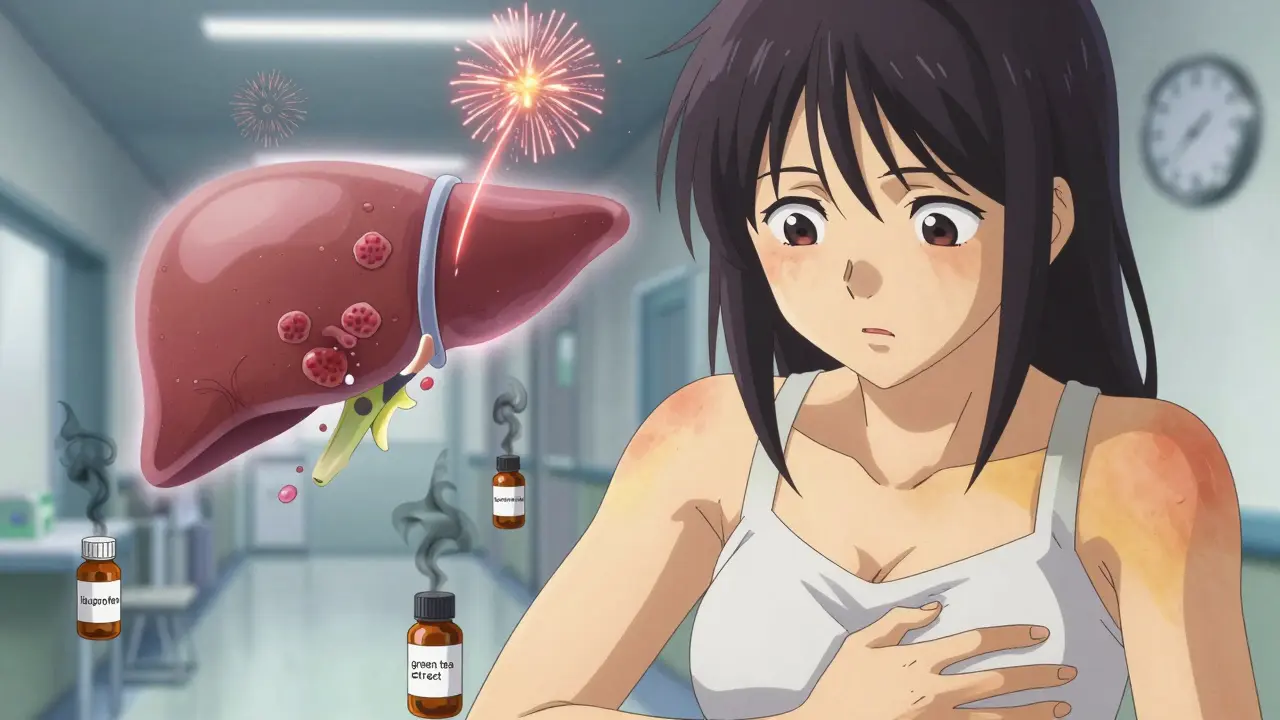
Here’s the hard truth: DILI often flies under the radar. A 2023 survey found that 68% of patients were misdiagnosed at first. Doctors thought it was flu, stress, or aging. By the time they tested the liver, it was already damaged.
You don’t need to wait for a blood test. If you’re taking any new medication - even if it’s ‘natural’ - and you notice any two of these signs within 8 weeks, get help immediately:
- Jaundice (yellow skin or eyes)
- Dark urine - like tea or cola
- Right upper abdominal pain - under your ribs on the right side
- Unexplained nausea or vomiting
- Severe itching without rash
One patient from Bristol told me (in a 2023 patient forum): “I had itching for two weeks on amoxicillin. My GP said it was allergies. By the time I went to A&E, my ALT was 1,200. I almost lost my liver.”
For acetaminophen, the rule is even simpler: if you took more than 4,000 mg in 24 hours (or 2,000 mg if you have liver disease), and you feel even slightly off - go to A&E. N-acetylcysteine, the antidote, works best if given within 8 hours. Every hour you wait cuts its effectiveness by 10%.
What Makes You More at Risk?
You might think only people with liver disease are at risk. But that’s not true. Even healthy people can develop DILI. However, some factors raise your chances:
- Age over 55 - liver function slows down.
- Drinking alcohol while on meds - this triples to quintuples your risk.
- Taking multiple drugs - especially if you’re on 5+ prescriptions or supplements.
- Genetic factors - some people carry HLA-B*57:01, which makes them 80 times more likely to get liver damage from flucloxacillin.
- Using supplements without telling your doctor - 68% of supplement users don’t mention them during medical visits.
And here’s something most people don’t know: statins - the cholesterol pills - are often blamed for liver damage. But European guidelines say true liver injury from statins is rarer than 0.01%. Most of the time, ALT rises a little and doesn’t mean anything serious. Don’t stop your statin unless your doctor says so.
How Do Doctors Diagnose It?
There’s no single test that says, “Yes, this drug did it.” That’s why DILI is called a diagnosis of exclusion. Your doctor has to rule out viruses, autoimmune disease, alcohol, and other causes first.
The gold standard is the RUCAM score - a tool that looks at:
- When you started the drug
- How long you took it
- Whether symptoms improved after stopping it
- Whether the same drug caused damage before
- Lab results
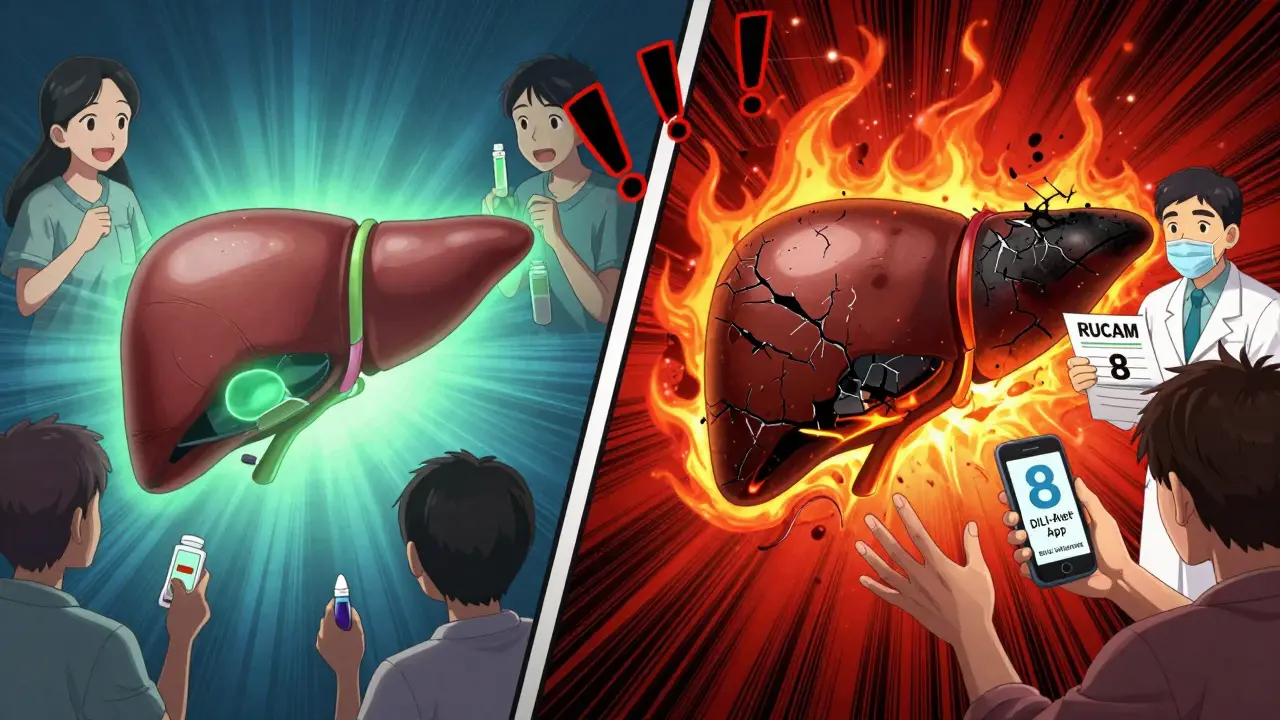
If your score is 8 or higher, it’s “definite” DILI. A score of 6-8 is “probable.” Below 3? Probably not. This system is 85% accurate - but only if your doctor knows to use it.
What You Can Do - Before It’s Too Late
You don’t have to wait for symptoms to get worse. Here’s how to protect yourself:
- Keep a medication log - write down every pill, capsule, and herbal tea. Include dosage and start date. Share it with every doctor you see.
- Know your limits - acetaminophen should never exceed 3,000 mg/day (2,000 mg if you have liver disease). That’s 6 regular tablets. Many products combine it with cold medicines - check labels.
- Avoid alcohol when taking any medication that affects the liver. Even one drink can push your risk over the edge.
- Ask before you supplement - “Is this safe for my liver?” is a question worth asking. Green tea extract, kava, and high-dose vitamin A are especially risky.
- Get tested if you’re on high-risk drugs - if you’re on isoniazid, methotrexate, or certain anticonvulsants, ask for liver enzyme checks every 4-6 weeks.
There’s new tech helping too. The FDA approved DILI-Alert in 2023 - a free app that checks your meds against a database of 1,200 liver-toxic compounds. It’s not perfect, but it’s better than guessing.
The Bigger Picture: Why This Is Getting Worse
Between 2015 and 2022, DILI cases in Europe rose by 27%. Why? Because more people are using unregulated supplements. In the US, hospitalizations for DILI jumped from 8.5 to 12.3 per 100,000 people in just 10 years. Each case costs an average of $18,500 and keeps someone in the hospital for over 5 days.
And the worst part? Most of this is preventable. Studies show 70% of severe cases could be avoided with better monitoring and patient education. Yet only 42% of primary care doctors in the UK can correctly identify the top 5 hepatotoxic drugs. And 68% of supplement users have no idea their “natural” pills might be hurting their liver.
We’re not talking about rare side effects. We’re talking about a silent epidemic - one that’s growing because we assume natural means safe. It doesn’t.
What Happens If You Ignore It?
Some people recover fully if they stop the drug early. Others don’t. DILI is now the leading cause of acute liver failure in the US, surpassing viral hepatitis since 2015. If your liver shuts down, you need a transplant - or you die.
There’s no miracle cure. No supplement will fix a damaged liver. The only treatment is stopping the drug and letting your liver heal - if it can. That’s why timing is everything.
Can over-the-counter painkillers damage my liver?
Yes. Acetaminophen (paracetamol) is the most common cause of drug-induced liver injury in the UK and US. Taking more than 3,000 mg in a day - even spread out - can cause serious damage. Many cold and flu medicines contain acetaminophen, so you might be doubling up without realizing it. Never exceed the recommended dose, and avoid alcohol while taking it.
Are herbal supplements safer than prescription drugs for my liver?
No. In fact, herbal and dietary supplements cause about 20% of all medication-related liver damage in the UK. Green tea extract, kava, and high-dose turmeric are among the most dangerous. Unlike prescription drugs, supplements aren’t tested for liver safety before being sold. Just because something is natural doesn’t mean it’s safe.
I feel fine. Do I still need liver tests if I’m on long-term medication?
If you’re on high-risk drugs like isoniazid, methotrexate, or certain anticonvulsants, yes. Up to 10% of people on isoniazid develop elevated liver enzymes within 3 months - even if they feel fine. Routine blood tests (ALT, AST, bilirubin) every 4-6 weeks can catch damage before symptoms appear. Don’t wait until you’re jaundiced.
Can statins cause liver damage?
Statins can raise liver enzymes slightly in a small number of people - but serious liver injury is extremely rare, affecting fewer than 1 in 10,000 users. The European Association for the Study of the Liver confirms this. If your ALT rises slightly but you feel fine, your doctor may just monitor it. Stopping statins without reason increases your risk of heart attack more than the liver risk.
What should I do if I suspect my medication is harming my liver?
Stop the medication immediately and contact your doctor. Don’t wait for symptoms to get worse. If you have jaundice, dark urine, or severe abdominal pain, go to A&E. Bring a list of everything you’re taking - including supplements. The sooner the drug is stopped, the better your chance of full recovery.
Write a comment
Items marked with * are required.




13 Comments
SNEHA GUPTA March 17, 2026 AT 20:19
It's terrifying how little we're taught about what our liver actually does. I used to think supplements were harmless because they're 'natural.' Now I check every ingredient like a forensic accountant. Green tea extract? I quit cold turkey after reading this. My ALT dropped 40% in 6 weeks. Your liver doesn't care if it's organic or vegan. It just processes toxins. Treat it like a precision instrument, not a trash can.
Gaurav Kumar March 19, 2026 AT 17:26
India has the highest rate of supplement abuse in the world. Everyone thinks ashwagandha is medicine. It's not. It's a chemical bomb wrapped in a yoga mat. I've seen 3 patients in my clinic with acute liver failure from 'Ayurvedic' blends. No regulation. No accountability. Just people self-medicating with herbs they found on Instagram. This article is right. We need a crackdown.
Jeremy Van Veelen March 19, 2026 AT 23:44
Let me tell you what really happened to my friend. She took 3 different 'liver detox' teas for 8 months. One had kava. Another had green tea extract. The third? Unlisted ingredients. She ended up in a transplant unit. They found 17 different hepatotoxic compounds in her system. And here's the kicker - she was 28. Healthy. No alcohol. No family history. Just 'natural' supplements. This isn't a medical issue. It's a cultural failure. We worship 'wellness' like a religion and ignore biology.
Laura Gabel March 21, 2026 AT 21:04
So basically don't take anything? Cool. I'll just keep taking my ibuprofen and hope for the best. My liver's fine. I'm 32. I don't need a lecture.
jerome Reverdy March 22, 2026 AT 09:35
Big picture: DILI is a systems failure. We've got 1,200+ drugs on the market with incomplete hepatotoxicity profiles. The FDA doesn't require long-term liver monitoring for most OTCs. Pharma doesn't fund studies on herb-drug interactions. And patients? They're left guessing. The solution isn't fear - it's transparency. Mandatory labeling. Public databases. Real-time monitoring. We have the tech. We just need the will.
Andrew Mamone March 23, 2026 AT 06:45
Just got my ALT levels back. 78. Normal range is 7–56. I'm on statins. Went to my doc. He said, 'Not unusual. Keep going.' I'm skeptical. I started logging everything - meds, supplements, even coffee. Turns out I was taking acetaminophen for headaches AND a cold med with it. Double dose. Stopped. Two weeks later: 49. 🤷♂️
Listen to your body. And read labels. Like, actually read them.
MALYN RICABLANCA March 25, 2026 AT 06:35
OH MY GOD. I JUST REALIZED I'VE BEEN TAKING GREEN TEA EXTRACT FOR 9 MONTHS BECAUSE MY YOGA INSTRUCTOR SAID IT 'BOOSTS METABOLISM' AND I JUST HAD MY LIVER ENZYMES CHECKED AND MY ALT IS 1,100??!!?? I'M GOING TO THE ER RIGHT NOW. MY MOM IS GOING TO KILL ME. I THOUGHT 'NATURAL' MEANT SAFE. I WAS WRONG. I'M A MORON. I'M SO SCARED. I'M CRYING. I'M GOING TO DIE. I NEED A LIVER TRANSPLANT. I'M SORRY, LIVER. I'M SO SORRY. 😭😭😭
gemeika hernandez March 26, 2026 AT 16:23
I took turmeric for my arthritis. Felt great. Then I got really tired. Yellow skin. Dark pee. Went to the doctor. They said 'stop the turmeric.' Done. Two weeks later, back to normal. So yeah. Supplements can hurt you. Don't be dumb.
Nicole Blain March 28, 2026 AT 01:30
My grandma took 7 supplements a day. Said they kept her 'young.' She ended up in the hospital with liver failure. Didn't know any of them interacted. We lost her. This post saved my life. I stopped everything. Now I only take what my doctor prescribes. And I write it all down. 🙏
Kathy Underhill March 29, 2026 AT 05:41
One thing missing from this post: the role of chronic low-dose exposure. Most people think DILI only happens after overdose. But repeated small doses - like daily green tea extract or long-term NSAID use - can slowly erode liver function. It’s cumulative. Silent. Like a leak in a pipe. By the time you see the puddle, the walls are rotting. Monitoring isn't paranoia. It's prevention.
Lauren Volpi March 30, 2026 AT 03:39
Why are we even talking about this? Americans are obsessed with pills. In Europe, we just eat food and walk. Problem solved. Stop overmedicating.
Kal Lambert March 30, 2026 AT 04:47
Log your meds. Talk to your doctor. Don't assume 'natural' = safe. Simple. Done.
Alexander Pitt April 1, 2026 AT 01:29
My sister was misdiagnosed with 'chronic fatigue' for 8 months. Turns out it was DILI from an herbal sleep aid. She's fine now. But if we hadn't found it? She'd be on a transplant list. Knowledge saves lives. Share this.