Health July 3, 2026
Pill Splitting Safety: Which Medications Are Safe to Split
Pill Splitting Safety Checker
Enter your medication details below to check if it is generally considered safe to split.
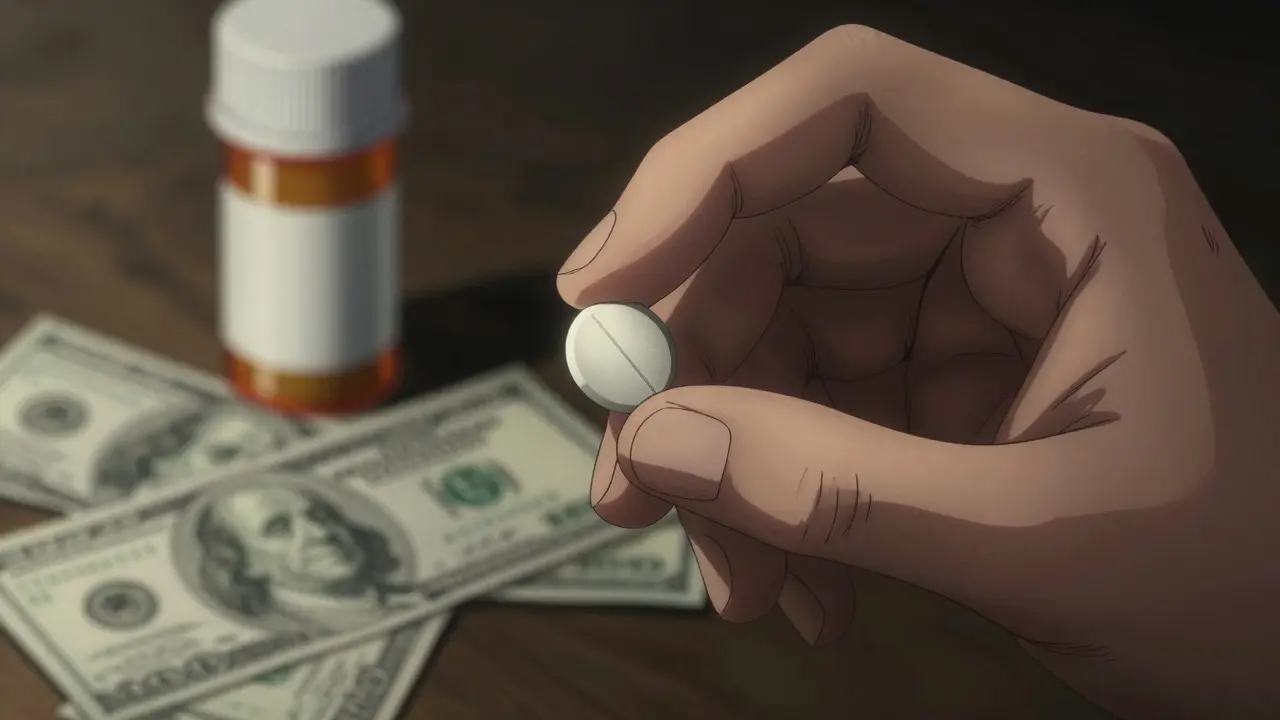
Imagine you’re holding a bottle of prescription medication that costs nearly $100 a month. You’ve heard from a friend-or maybe read it online-that you can cut the pill in half, take two lower doses, and save yourself a bundle. It sounds like a no-brainer, right? But here’s the catch: cutting a pill isn’t just about geometry. It’s chemistry. And getting it wrong can mean you’re either under-dosing your condition or accidentally overdosing yourself.
Pill splitting is a real strategy used by millions to manage healthcare costs, especially when insurance coverage is thin. However, not every tablet is built to be divided. Some are designed to release medicine slowly over 24 hours; others have special coatings to protect your stomach. Break those designs, and you break the safety mechanism. This guide breaks down exactly which pills are safe to split, which ones are dangerous, and how to do it correctly if your doctor gives you the green light.
The Golden Rule: The Score Line
If you look at your pill bottle, check the tablets closely. Do they have a line running down the middle? This is called a score line. In the world of pharmacology, this line is your best friend. It indicates that the manufacturer tested the tablet for splitting and confirmed it divides evenly enough to maintain dose accuracy.
However, don’t get too comfortable. According to FDA guidance, even some scored tablets might not split perfectly due to their formulation. A score line means "it’s possible," not "it’s guaranteed." Always pair visual inspection with professional advice. If there is no score line, assume the pill is not meant to be split unless a pharmacist explicitly tells you otherwise.
Medications That Are Generally Safe to Split
Most immediate-release tablets are good candidates for splitting. These are pills designed to dissolve quickly in your stomach so the drug enters your bloodstream fast. Because they don’t rely on complex release mechanisms, breaking them usually doesn’t change how the drug works-just how much you get at one time.
Common categories include:
- Blood Pressure Medications: Drugs like amlodipine, lisinopril, and losartan are frequently prescribed in strengths that can be halved safely. For example, splitting a 10mg amlodipine tablet often saves patients significant money compared to buying the 5mg version, provided the tablet is scored.
- Antidepressants: Many SSRIs like citalopram (Celexa), escitalopram (Lexapro), and sertraline (Zoloft) come in scored versions suitable for splitting. This allows doctors to fine-tune doses without prescribing multiple different pills.
- Cholesterol Medications: Statins such as atorvastatin (Lipitor) and simvastatin are often safe to split if they are immediate-release and scored.
- Sedatives: Certain benzodiazepines like diazepam (Valium) are commonly split to achieve precise dosing for anxiety or muscle spasms.
Even if a pill falls into these categories, always verify with your pharmacist. Formulations change, and generic manufacturers may alter ingredients that affect how well a pill splits.

The Danger Zone: Pills You Should Never Split
Some medications are engineered with specific technologies that control how and when the drug is released. Destroying that engineering can lead to serious health risks, including toxicity or treatment failure.
| Type of Pill | Why It’s Dangerous | Examples |
|---|---|---|
| Extended-Release (ER, XR, SR, LA) | Releases drug slowly over time. Splitting dumps the entire dose at once, risking overdose. | Oxycodone ER (OxyContin), Metformin XR, Gabapentin ER |
| Enteric-Coated (EC) | Coating protects stomach acid or ensures drug dissolves in intestines. Splitting exposes drug to stomach acid, causing irritation or degradation. | Aspirin EC, Omeprazole, Alendronate (Fosamax) |
| Capsules | Contain powder, beads, or gel. Cannot be cut evenly; contents spill out. | Adderall capsules, Vyvanse, Most antibiotics in capsule form |
| Hazardous Drugs | Dust from splitting can be toxic to handlers (reproductive toxins, carcinogens). | Chemotherapy agents, Methotrexate |
| Narrow Therapeutic Index (NTI) | Small dose changes cause big effects. Uneven splits can lead to toxicity or lack of efficacy. | Warfarin, Lithium, Phenytoin, Levothyroxine |
Notice the abbreviations on your label? If you see XR, ER, SR, CR, LA, or XL, stop. Those stand for Extended Release, Sustained Release, Controlled Release, Long Acting, or Extra Long. These pills use matrices or osmotic pumps to meter out medicine. Cutting them bypasses the timer, flooding your system with a full day’s worth of medication in minutes. This is particularly dangerous with painkillers like oxycodone or blood pressure meds, where a sudden spike can be fatal.
Enteric-coated pills are another trap. Take alendronate (Fosamax), used for osteoporosis. It has a coating to prevent it from irritating your esophagus. If you split it, the raw drug touches your throat and stomach lining, potentially causing severe ulcers or bleeding. Similarly, aspirin enteric-coated is designed to bypass the stomach to avoid gastritis. Splitting it defeats that purpose.
How to Split Pills Safely and Accurately
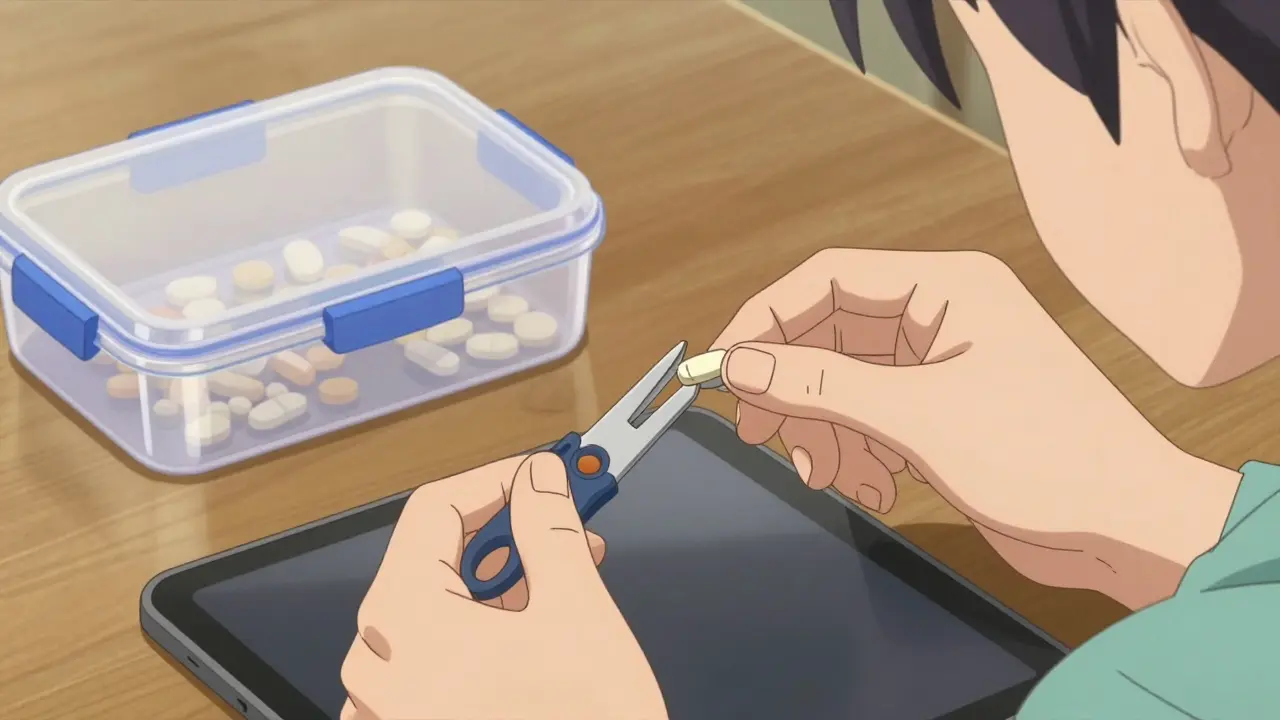
If your doctor and pharmacist agree that your medication is safe to split, technique matters. Using a knife or scissors is a bad idea. Studies show that using household tools results in dose variations of 25% to 40%. That means one half might have 75% of the drug, and the other only 25%. For sensitive conditions, that inconsistency is unacceptable.
- Buy a Tablet Cutter: These inexpensive devices (usually $5-$25) have a blade and slots that hold the pill steady. They reduce dose variation to 7-12%, which is clinically acceptable for most drugs.
- Split Immediately Before Use: Don’t split your whole month’s supply on Sunday night. Once a pill is cut, the inner core is exposed to air and moisture. Potency can degrade significantly within days. The Institute for Safe Medication Practices recommends splitting only what you need for the next dose.
- Use Proper Storage: If you must store halves, keep them in an opaque, airtight container. Light and humidity are enemies of drug stability. Replace any stored halves after 72 hours to ensure potency.
- Wash Your Hands: Especially important if you’re handling hazardous drugs or simply maintaining hygiene. Residue can transfer to surfaces or skin.
- Check for Crumbling: Some pills are brittle. If your pill crumbles instead of slicing cleanly, it’s not a candidate for splitting, regardless of the score line. Discard the crumbs-you can’t guarantee the dose.
The Cost vs. Risk Calculation
Why do people split pills? Mostly money. A 30mg tablet often costs the same as a 15mg tablet because manufacturing and packaging costs are fixed. By splitting, you effectively double your supply. For a patient paying out-of-pocket, this can save hundreds of dollars annually.
But consider the hidden costs. If you split a narrow therapeutic index drug like warfarin (a blood thinner) incorrectly, you risk bleeding events or clots. The emergency room visit will cost far more than the savings. Additionally, some insurance plans cover lower-dose generics better than higher-dose ones. Sometimes, asking your doctor to switch prescriptions to a cheaper, lower-dose option is safer and easier than splitting.
Also, think about convenience. Taking two half-pills requires more effort than swallowing one whole pill. For seniors with arthritis or dexterity issues, operating a tablet cutter can be frustrating. Surveys show that 42% of seniors with arthritis abandon pill splitting because it’s physically difficult. If splitting causes stress or errors, it’s not worth the savings.
When to Talk to Your Pharmacist
Your pharmacist is the ultimate authority on pill splitting. They have access to detailed monographs that tell them exactly how each formulation behaves. Bring your pill bottle to the counter. Ask:
- "Is this tablet scored for splitting?"
- "Does this drug have a narrow therapeutic index?"
- "Are there cheaper generic alternatives available?"
- "Can you demonstrate how to split this pill?"
Many pharmacists will gladly show you how to use a cutter. Some even provide free tablet splitters. Don’t hesitate to ask. It’s a standard part of medication counseling, and it could prevent a serious error.
Remember, pill splitting is a tool, not a rule. It works beautifully for simple, scored, immediate-release tablets. It fails dangerously for complex, coated, or timed-release formulations. Always prioritize safety over savings. When in doubt, swallow the whole pill or consult a professional.
Can I split my vitamin pills?
Generally, yes. Most multivitamins and single-nutrient supplements (like Vitamin D or Calcium) are safe to split if they are scored. However, some vitamins are enteric-coated to protect against stomach acid or improve absorption. Check the label for "EC" or "enteric-coated." If present, do not split. Also, splitting large gummy vitamins is impractical and messy.
What does "XR" mean on a pill?
"XR" stands for Extended Release. These pills are designed to release medication slowly over several hours or days. Splitting an XR pill destroys the release mechanism, causing the entire dose to enter your body at once. This can lead to dangerous side effects or overdose. Never split pills labeled XR, ER, SR, LA, or CR.
Is it safe to split antibiotics?
It depends on the type. Many liquid antibiotic suspensions are already mixed for precise dosing. Solid tablets should only be split if they are scored and immediate-release. Avoid splitting enteric-coated antibiotics or those in capsule form. Always confirm with your pharmacist, as inaccurate dosing can lead to antibiotic resistance or treatment failure.
How long can I store split pills?
Ideally, you should split pills immediately before taking them. If you must store them, keep them in an airtight, opaque container away from light and moisture. Most experts recommend replacing stored halves every 72 hours to ensure potency. Do not store split pills for weeks or months, as degradation can occur rapidly once the protective coating is broken.
Can I split sublingual tablets?
Sublingual tablets (placed under the tongue) are often small and scored. Examples include nitroglycerin for chest pain. While technically possible to split, it’s risky because dose accuracy is critical for life-saving medications. Only split sublingual tablets if explicitly instructed by your doctor and if the tablet is clearly scored. Otherwise, buy the correct low-dose strength.