Health June 1, 2026
Basal Cell vs. Squamous Cell Carcinoma: Key Differences, Risks, and Treatment
Most people hear "skin cancer" and immediately think of melanoma. It gets the most media attention because it is deadly if ignored. But here is the reality check: nonmelanoma skin cancer is far more common than melanoma. In fact, cases of basal cell carcinoma (BCC) and squamous cell carcinoma (SCC) outnumber melanoma diagnoses significantly. While these two types are highly treatable when caught early, they behave differently, look different, and carry different risks. Knowing the difference isn't just medical trivia-it could save your skin.
What Exactly Is Nonmelanoma Skin Cancer?
To understand the difference between BCC and SCC, you first need to know where they start. Your skin has an outer layer called the epidermis. This layer is made up of different types of cells that do specific jobs.
Basal cell carcinoma starts in the basal cells located at the bottom of the epidermis. These are the factory workers of your skin, constantly dividing to create new cells. When DNA damage from UV radiation causes these cells to mutate and grow uncontrollably, BCC forms.
Squamous cell carcinoma begins in the squamous cells found in the upper layers of the epidermis. As basal cells move upward, they flatten out and become squamous cells. If these cells get damaged by the sun or other factors, they can turn into SCC.
Both cancers are primarily caused by ultraviolet (UV) radiation exposure. About 80% of these cases appear on sun-exposed areas like your face, neck, ears, and hands. However, their behavior after forming is where the story changes.
Basal Cell Carcinoma: The Slow Grower
BCC is the most common form of cancer in humans. According to data from the American Cancer Society, it accounts for roughly 80% of all nonmelanoma skin cancer cases. You might have heard it described as "the cancer that rarely kills." That’s mostly true, but with a big caveat: it rarely spreads to other parts of the body, but it can destroy local tissue if left alone.
How does BCC look?
- Pearly bumps: Shiny, translucent, or pinkish nodules with visible blood vessels on the surface. This is the most common presentation, seen in about 70% of cases.
- Non-healing sores: An open sore that bleeds, crusts over, heals, and then opens up again. It might itch or hurt slightly.
- Scar-like patches: Flat, yellowish, or waxy areas that look like old scars but don’t heal.
BCC grows slowly. On average, it expands at a rate of 0.5 to 1.0 centimeter per year. Because it stays localized, it is often easier to remove completely. The metastasis rate-the chance it spreads to lymph nodes or organs-is fewer than 0.1%. However, if you ignore a large BCC on your nose or eye for years, it can eat through cartilage and bone, causing significant disfigurement.
Squamous Cell Carcinoma: The Aggressive Cousin
If BCC is the slow walker, SCC is the runner. SCC accounts for about 20-23% of nonmelanoma skin cancers. While still very treatable, it is considered more serious than BCC because it has a higher potential to spread.
What does SCC look like?
- Firm red nodules: Dome-shaped growths that feel hard to the touch.
- Scaly patches: Rough, reddish areas that may flake or bleed easily.
- Wart-like lesions: Raised growths that can resemble warts but are distinct in texture.
- Crusting sores: Open wounds that crust over and fail to heal within a few weeks.
SCC grows faster than BCC, averaging 1.5 to 2.0 centimeters per year. Some aggressive subtypes can double in size within just four to six weeks. The metastasis rate for SCC is between 2% and 5% overall. However, this number jumps dramatically depending on location. SCC on the lips has a 14% metastasis rate, while ear SCC carries a 9% risk. This makes location a critical factor in treatment urgency.
| Feature | Basal Cell Carcinoma (BCC) | Squamous Cell Carcinoma (SCC) |
|---|---|---|
| Prevalence | ~80% of nonmelanoma cases | ~20-23% of nonmelanoma cases |
| Growth Rate | Slow (0.5-1.0 cm/year) | Faster (1.5-2.0 cm/year) |
| Metastasis Risk | <0.1% | 2-5% (up to 15% in high-risk zones) |
| Common Appearance | Pearly bump, non-healing sore | Firm red nodule, scaly patch |
| Primary Cause | Intermittent intense sunburns | Cumulative long-term sun exposure |
| Average Age at Diagnosis | 67 years | 69 years |
Who Is at Highest Risk?
You don't have to be fair-skinned to get skin cancer, but lighter skin tones do carry higher risk due to less natural protection against UV rays. Both BCC and SCC incidence rates skyrocket after age 50, with 85% of cases occurring in people over fifty. However, younger adults are seeing rising rates, likely due to tanning bed use and changing outdoor habits.
Gender plays a role too. SCC shows a stronger male predominance (65% male vs. 35% female), which experts link to historical occupational sun exposure-think farmers, construction workers, and sailors. BCC is more evenly split, though men still slightly outnumber women.
The biggest risk multiplier is being immunocompromised. Organ transplant recipients face a staggering 250-fold increased risk of developing SCC compared to the general population. Their risk for BCC increases tenfold. This is why dermatologists monitor transplant patients so closely.
Diagnosis and Treatment Options
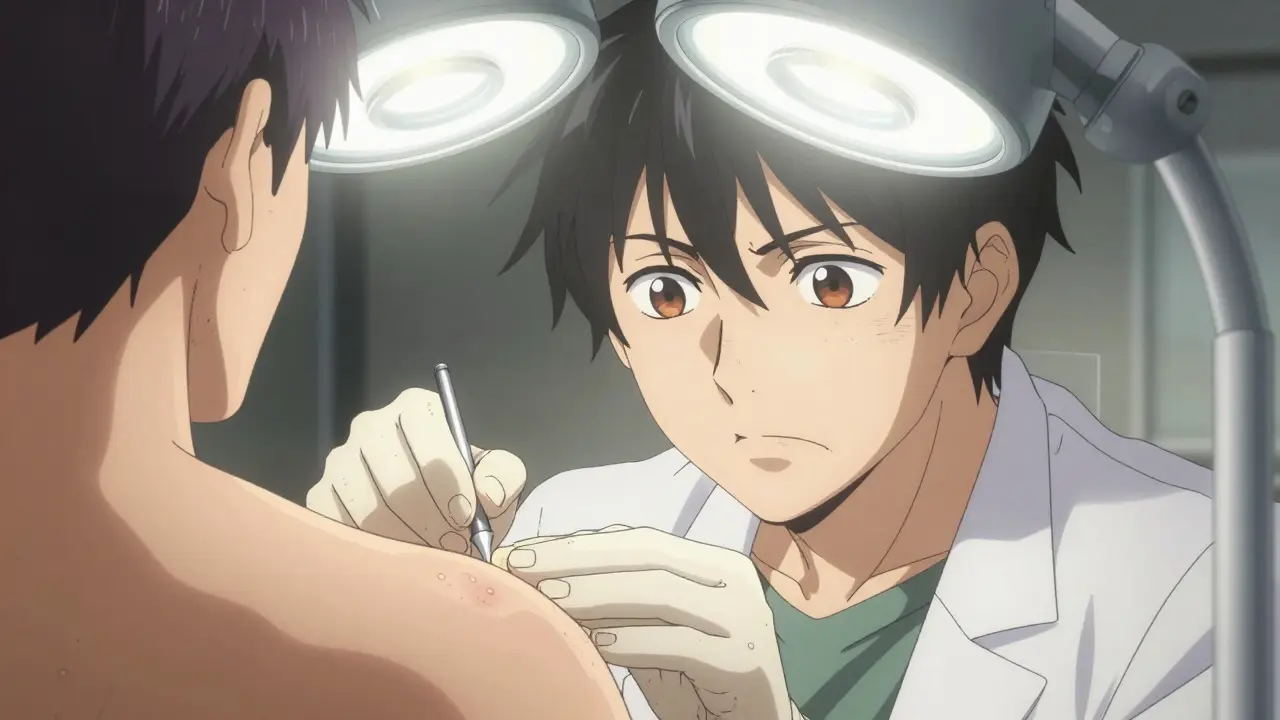
If you spot something suspicious, see a dermatologist. They will likely perform a biopsy, removing a small piece of tissue to examine under a microscope. This is the only way to definitively distinguish between BCC, SCC, and other conditions.
Treatment depends on the type, size, and location of the tumor.
For superficial BCC, topical medications like imiquimod or 5-fluorouracil can be effective, clearing 60-70% of lesions. SCC responds less well to topicals, with clearance rates around 40-50%, often requiring procedural intervention.
Surgical excision is the gold standard for both. Surgeons cut out the cancer along with a margin of healthy tissue to ensure no cancer cells remain. For low-risk BCC, margins of 3-5 millimeters are typical. For high-risk SCC, surgeons take wider margins-4 to 10 millimeters-because SCC is more likely to have microscopic extensions deeper into the skin.
Mohs micrographic surgery is a precise surgical technique used for skin cancer removal. This method is often preferred for tumors on the face or those that have recurred. During Mohs surgery, the doctor removes thin layers of skin one at a time, examining each under a microscope immediately. This continues until no cancer cells are found. Mohs surgery achieves 99% cure rates for primary BCC and 97% for primary SCC, while sparing as much healthy tissue as possible.
Other treatments include cryotherapy (freezing the cancer with liquid nitrogen), curettage and electrodessication (scraping and burning), and radiation therapy for patients who cannot undergo surgery. Recently, immunotherapy drugs like cemiplimab have been approved for advanced, metastatic SCC, offering hope for cases that surgery can't fix.
Prevention: Stopping It Before It Starts
Prevention is your best defense. Since UV radiation is the main culprit, protecting your skin is non-negotiable.
- Daily Sunscreen: Use broad-spectrum SPF 30 or higher every day, even when cloudy. Studies show daily sunscreen use reduces BCC risk by 40% and SCC risk by 50%.
- Seek Shade: Avoid direct sun between 10 a.m. and 4 p.m., when UV rays are strongest.
- Protective Clothing: Wear wide-brimmed hats, UV-blocking sunglasses, and long sleeves. UPF-rated clothing offers reliable protection.
- No Tanning Beds: Artificial UV radiation is just as damaging as natural sunlight and significantly increases SCC risk.
- Self-Exams: Check your skin monthly. Look for new spots or changes in existing moles. Remember the ABCDEs of melanoma, but also watch for non-healing sores or pearly bumps.
If you have a history of skin cancer, fair skin, or a weakened immune system, schedule regular dermatological exams. High-risk patients should see a dermatologist every three to four months. Early detection keeps cure rates above 90% for both BCC and SCC.
Living With a History of Skin Cancer
Getting diagnosed with BCC or SCC can be scary, but try not to panic. These are among the most curable cancers. The key is vigilance. Having one skin cancer increases your risk of getting another. About 37% of SCC patients worry about recurrence, compared to 22% of BCC patients, reflecting the slightly higher stakes with SCC.
Follow-up appointments aren't just bureaucracy; they are safety nets. Most recurrent SCC cases are detected within 12 months of treatment, while BCC recurrences often take longer to appear. Stick to your schedule. Protect your skin. And remember, catching it early means simpler treatment and better cosmetic outcomes.
Is squamous cell carcinoma more dangerous than basal cell carcinoma?
Yes, generally speaking. While both are highly treatable, squamous cell carcinoma (SCC) has a higher potential to metastasize (spread to other parts of the body) compared to basal cell carcinoma (BCC). BCC rarely spreads (<0.1%), whereas SCC metastasizes in 2-5% of cases, with higher rates in locations like the lips and ears. SCC also tends to grow faster and invade deeper tissues.
Can you tell the difference between BCC and SCC just by looking?
You can suspect based on appearance, but only a biopsy can confirm. BCC often looks like a pearly, shiny bump or a non-healing sore. SCC typically appears as a firm, red nodule, a scaly patch, or a wart-like growth. Because appearances can overlap, any new or changing skin lesion should be evaluated by a dermatologist.
How fast does nonmelanoma skin cancer grow?
Growth rates vary. Basal cell carcinoma grows slowly, usually expanding 0.5 to 1.0 centimeter per year. Squamous cell carcinoma grows faster, averaging 1.5 to 2.0 centimeters per year. Some aggressive SCC subtypes can double in size within 4-6 weeks, which is why prompt evaluation of rapidly changing lesions is crucial.
What is the cure rate for BCC and SCC?
When detected and treated early, both BCC and SCC have excellent cure rates, often exceeding 90-95%. Surgical excision and Mohs surgery are highly effective. The five-year survival rate for localized SCC is 95%, but drops significantly if it metastasizes. BCC almost never metastasizes, making its prognosis extremely favorable regarding life expectancy, though it can cause local tissue damage if ignored.
Why do organ transplant recipients have higher skin cancer risk?
Immunosuppressive drugs taken to prevent organ rejection weaken the body's ability to fight off abnormal cells. This leads to a dramatically increased risk of skin cancers, particularly SCC. Transplant recipients have a 250-fold higher risk of SCC and a 10-fold higher risk of BCC compared to the general population, necessitating rigorous skin surveillance.